
What Is a Behavior Intervention Plan? Parent & Educator Guide
Discover what is a behavior intervention plan and how it supports students. Learn strategies for effectively managing challenging behaviors today!
What Is a Behavior Intervention Plan? Parent & Educator Guide
TL;DR:
- A behavior intervention plan is a written strategy designed to support students with challenging behaviors that disrupt learning. It is developed through a structured process involving functional behavioral assessments and collaboration among educators, parents, and specialists. An effective BIP focuses on understanding the behavior’s function, teaching alternative responses, and consistently monitoring progress to improve student outcomes.
A behavior intervention plan (BIP) is a formal, written strategy designed to support students whose challenging behaviors interfere with learning. The plan applies to any student whose behavior disrupts the classroom or their own progress, not only those with an IEP or 504 plan. Parents, educators, school psychologists, and behavior specialists all contribute to building and carrying out an effective BIP. When done well, a BIP shifts the focus from punishment to understanding what a child’s behavior is communicating and teaching a better way to meet that need.
What is a behavior intervention plan and who needs one?
A BIP is a documented, individualized plan that identifies a specific problem behavior, explains why it occurs, and outlines concrete strategies to replace it. The behavioral support plan targets skill-building and proactive environmental changes rather than reactive consequences. Under the Individuals with Disabilities Education Act (IDEA), federal law mandates BIPs for students with disabilities in certain disciplinary situations, making them legally enforceable parts of IEPs. However, any student whose behavior consistently disrupts learning can benefit from one, regardless of disability status.

The purpose of a behavior intervention plan is not to control a child. It is to understand what function the behavior serves, whether that is seeking attention, avoiding a task, or accessing something they want, and then teach a more appropriate way to meet that same need. This reframe changes everything about how adults respond.
How is a behavior intervention plan developed?
BIP development follows a structured process that begins with a Functional Behavioral Assessment (FBA). The FBA is a data-gathering process that typically spans several weeks and involves collaboration among educators, family members, and specialists such as school psychologists or behavior analysts. The goal is to identify the function of the behavior, meaning the reason behind it, before any intervention is designed.
Here are the core steps in creating a behavior plan:
- Identify the target behavior. Define it clearly and specifically. “Hits peers during transitions” is measurable. “Acts out” is not.
- Conduct the FBA. Collect data through observation, interviews with parents and teachers, and behavior rating scales. Look for patterns in when and where the behavior occurs.
- Determine the behavior’s function. Common functions include attention-seeking, escape or avoidance, access to preferred items, and sensory input.
- Draft the BIP. Use FBA findings to select replacement behaviors, antecedent strategies, reinforcement plans, and crisis procedures.
- Review with the team. Parents, educators, and specialists review the draft together before implementation begins.
- Implement and monitor. Assign responsibilities to specific staff and set a timeline for reviewing progress data.
Pro Tip: Ask the school for a copy of the FBA report before the BIP meeting. Reading it in advance gives you time to ask better questions and catch any gaps in the data.
The role of ABA therapy in this process is worth understanding. Applied Behavior Analysis principles often guide how FBAs are structured and how replacement behaviors are selected, even in school settings that do not use formal ABA services.
What are the key components of a behavior intervention plan?
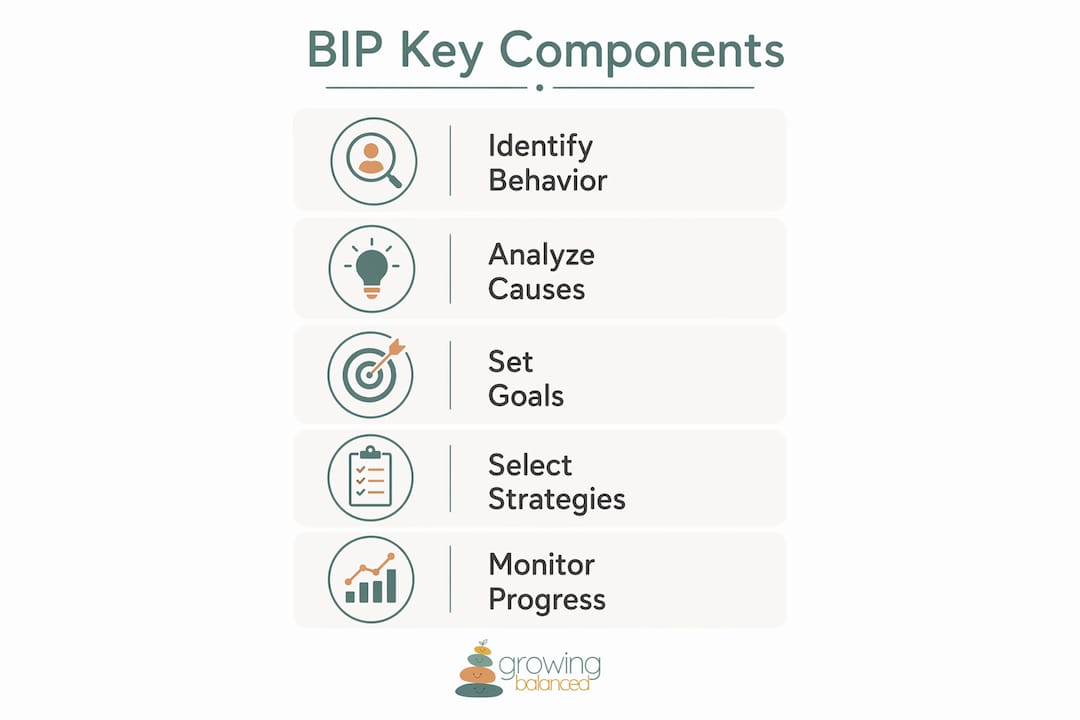
An effective BIP is not a vague list of good intentions. Every component must be specific, measurable, and tied directly to the FBA findings. Here are the elements every strong plan includes:
- Target behavior description. A precise, observable definition of the behavior being addressed. The team must agree on exactly what counts as the behavior before they can track it.
- Behavior function. A clear statement of why the behavior occurs, based on FBA data. This drives every other decision in the plan.
- Replacement behaviors. Alternative behaviors that serve the same function as the problem behavior. A child who shouts to escape a task might be taught to request a break using a break card instead.
- Antecedent strategies. Changes to the environment or routine that reduce the likelihood of the behavior occurring in the first place. These are proactive, not reactive.
- Reinforcement strategies. Specific, consistent rewards or acknowledgments that encourage the replacement behavior and other positive behaviors.
- Crisis intervention procedures. A clear protocol for keeping the student and others safe if the behavior escalates beyond typical intervention.
- Progress monitoring. Defined data collection methods, timelines, and the staff member responsible for tracking outcomes.
The table below shows how a BIP component connects to a real classroom example:
| BIP Component | Example |
|---|---|
| Target behavior | Leaves seat more than 5 times per 30-minute block |
| Behavior function | Escape from difficult tasks |
| Replacement behavior | Raises hand to request a movement break |
| Antecedent strategy | Shorten task length; add a visual timer |
| Reinforcement | Earns 5 minutes of preferred activity after completing work |
| Progress monitoring | Teacher records frequency daily using a tally sheet |
Understanding positive behavior support helps put these components in context. PBS frameworks and BIPs share the same core philosophy: build skills, modify environments, and reinforce what you want to see more of.
What are the benefits of implementing a BIP effectively?
A well-implemented BIP produces measurable improvements in student behavior and classroom climate. Clear documented procedures reduce reactive trial and error among educators, which means students receive consistent responses every time a behavior occurs. Consistency is one of the strongest predictors of behavior change.
“The shift from ‘what’s wrong with this child’ to ‘what need does this behavior meet’ is where real progress begins. BIPs make that shift concrete and actionable for every adult in the room.” — LegalClarity
Beyond behavior reduction, students gain actual skills. Teaching a child to use a break card, request help, or signal frustration with words builds self-regulation capacity that carries beyond the classroom. Teachers also report less stress when they have a clear, agreed-upon plan rather than improvising responses in the moment.
Pro Tip: Track not just the problem behavior but also how often the replacement behavior occurs. Seeing the replacement behavior increase is often the earliest sign that the plan is working, even before the problem behavior fully decreases.
Students with BIPs also tend to show improved engagement when their behavioral needs are met proactively. A child who is no longer overwhelmed by unmanageable demands has more cognitive space to learn.
How can parents and educators collaborate on a BIP?
Collaboration between home and school is not optional. It is the factor that most often determines whether a BIP succeeds or stalls. Consistent home-school approaches and timely reviews prevent frustration and maximize the plan’s effectiveness.
Here is how parents and educators can build a strong partnership around a BIP:
- Attend every BIP meeting. Parents are legal members of the IEP and BIP team. Your observations about behavior at home are data the school cannot collect on its own.
- Ask for plain-language explanations. If a term like “antecedent modification” is used without explanation, ask what it means in practice. You have every right to understand every part of the plan.
- Replicate key strategies at home. If the school uses a break card system, use the same card at home. Mismatched approaches across settings slow progress significantly.
- Request regular data updates. Ask how often data is reviewed and what the plan is if the behavior does not improve within a set timeframe.
- Advocate for timely FBAs. Data collection must happen before and during implementation. If weeks pass without a formal assessment, push for one.
Learning how to build a behavior support plan alongside the school team gives parents a stronger voice in the process and a clearer picture of what good implementation looks like.
What i have learned after working with families on bips
The most common mistake I see is a mismatch between the replacement behavior and the behavior’s actual function. A team will teach a child to raise their hand quietly when the behavior is driven by sensory overload, not attention-seeking. The replacement behavior fails because it does not meet the same need. The child goes right back to the original behavior, and everyone assumes the plan does not work. The plan was never the problem. The function identification was.
The second thing I have learned is that patience with data is non-negotiable. Behavior change is not linear. A child might show more problem behavior in the first two weeks of a BIP as they test whether the new system is consistent. Teams that abandon the plan at that point never see the results that come at week six. Stick with it, keep collecting data, and adjust based on what the numbers show, not how the week felt.
For parents, my strongest advice is this: do not wait for the school to initiate. If your child’s behavior is affecting their learning or their relationships, request a meeting and ask specifically about an FBA. You do not need to know all the terminology. You just need to ask the right question.
— Kelsey
How Growingbalanced supports behavior plans at home and school
Building a BIP is only part of the work. The other part is creating the daily structure that makes the plan stick.
Growingbalanced offers visual schedules and daily routines built on occupational therapy principles, designed to complement the kind of antecedent strategies and environmental supports that BIPs rely on. When a child knows what comes next, the triggers for challenging behavior decrease. Growingbalanced gives parents and teachers the tools to build that predictability at home, in the classroom, and across both settings. Explore the platform’s free resources and printable materials to find what fits your child’s specific needs.
FAQ
What is a behavior intervention plan in simple terms?
A behavior intervention plan is a written document that identifies a specific challenging behavior, explains why it occurs, and outlines strategies to teach a better alternative. It is built around the child’s needs, not punishment.
Who creates a behavior intervention plan?
A BIP is created by a team that includes the student’s parents, teachers, school psychologist, and any relevant specialists. Parents are legal members of the team and must be included in the process.
Does a child need an IEP to have a BIP?
No. Any student whose behavior interferes with their own learning or the learning of others can receive a BIP, regardless of whether they have an IEP or 504 plan.
How long does it take to develop a BIP?
The FBA process that precedes a BIP typically takes several weeks of data collection. The full plan is then drafted, reviewed by the team, and implemented with an agreed-upon monitoring schedule.
What happens if a BIP is not working?
The team should review current data, re-examine whether the behavior function was correctly identified, and adjust the replacement behaviors or strategies accordingly. Abandoning the plan prematurely is the most common reason BIPs appear to fail.
Recommended
- How to build a behavior support plan for your classroom · Growing Balanced Blog
- What Is Positive Behavior Support (PBS) for Kids · Growing Balanced Blog
- Behavioral Regulation Classroom Strategies Explained · Growing Balanced Blog
- Behavioral Support Strategies for Elementary Teachers · Growing Balanced Blog