
How to build a behavior support plan for your classroom
Learn how to build a behavior support plan classroom that truly works. This guide helps you understand student needs and implement effective strategies.
How to build a behavior support plan for your classroom
You know the moment: a student shuts down, bolts from their seat, or melts into a full meltdown right in the middle of a lesson, and the rest of the class goes sideways with them. When you need to build a behavior support plan for the classroom, it is tempting to reach for a generic template and hope for the best. But students with sensory regulation needs require something more targeted. This guide walks you through every step, from identifying why the behavior happens to monitoring whether your plan is actually working, so you can stop guessing and start supporting.
Table of Contents
- How to build a behavior support plan classroom teachers can actually use
- Setting clear expectations and selecting evidence-based strategies
- Incorporating sensory regulation needs into behavior support plans
- Monitoring implementation and revising plans based on data
- Common pitfalls and pro tips for effective classroom behavior support plans
- A fresh perspective: Why simple, focused plans best support sensory regulation needs in classrooms
- How Growing Balanced supports your classroom behavior plans
- Frequently asked questions
Key Takeaways
| Point | Details |
|---|---|
| Assess behavior function | Start your plan by understanding the reason behind behaviors with a Functional Behavioral Assessment. |
| Set clear expectations | Limit classroom rules to 3-5 positively stated and observable behaviors to focus your support. |
| Focus plans narrowly | Target one behavior and one routine with 1-2 strategies over 2 weeks for manageable, effective intervention. |
| Include sensory supports | Adapt plans for sensory needs using fidget menus, visual timers, and executive scaffolds to reduce overload. |
| Monitor and revise | Use fidelity checklists and data to monitor plan implementation and revise if needed after 2-3 weeks. |
How to build a behavior support plan classroom teachers can actually use
Building a plan that sticks starts long before you write a single strategy. The most important work happens in the observation phase, where you figure out the function of the behavior. That means asking not just what the student is doing, but why.
Understanding behavior functions and gathering data
A Functional Behavioral Assessment, or FBA, is the foundation of any effective classroom behavior plan. It is a structured process of collecting data to understand what triggers a behavior and what the student gets out of it. Building a function-based plan starts with an FBA involving data collection over 5 to 10 days, followed by creating a Competing Behavior Pathway.
The Competing Behavior Pathway is a visual map that shows three things side by side: the problem behavior the student currently uses, the replacement behavior you want to teach, and the desired behavior that is the long-term goal. The replacement behavior is key. It must serve the same function as the problem behavior. If a student is throwing materials to escape a loud, overstimulating group activity, the replacement behavior needs to offer that same escape, just in an acceptable way, like requesting a quiet break.
Here is what solid FBA data collection looks like in practice:
- ABC charts: Record the Antecedent (what happened right before), the Behavior (exactly what the student did), and the Consequence (what happened after). Do this across different times of day and settings.
- Setting events: Note anything that might prime the behavior, such as a disrupted morning routine, missed medication, or a noisy hallway before class.
- Frequency and duration: Track how often the behavior occurs and how long it lasts to establish a baseline.
- Staff interviews: Ask everyone who works with the student, because patterns often show up across multiple observers.
Pro Tip: Do not rely on memory. Keep a small notepad or use a simple tally sheet clipped to your clipboard for real-time recording. Even five minutes of consistent daily data is more useful than a detailed narrative written at the end of the week.
Setting clear expectations and selecting evidence-based strategies
With behavior functions understood, the next step is to define what you actually expect from students and choose the strategies that will get you there.
Limiting classroom expectations to three to five observable, positively stated statements improves positive behavior supports significantly. That means “Keep hands to yourself” instead of “No hitting,” and “Use a quiet voice in the hallway” instead of “Stop being loud.” Positively phrased expectations tell students what to do, not just what to stop.
Once you have your expectations, resist the urge to target everything at once. A focused four-question plan that addresses one expectation, one routine, one or two evidence-based strategies, and a two-week monitoring window is often more effective than a sprawling document no one can implement consistently.
Here are the steps to develop a behavior plan that is both focused and functional:
- Identify the one expectation that, if improved, would have the biggest positive impact on the student’s day.
- Select the one routine where the behavior most often breaks down, such as transitions, independent work time, or arrival.
- Choose one to two strategies from the evidence base, such as behavior-specific praise, precorrection, or active supervision.
- Set a monitoring window of two weeks with a clear decision point at the end.
- Define what success looks like before you start, so you are not moving the goalposts mid-plan.
The table below shows how common strategies map to different behavior functions:
| Strategy | Best for behavior function | How it works |
|---|---|---|
| Behavior-specific praise | Attention-seeking | Reinforces desired behavior with specific, immediate feedback |
| Precorrection | Escape or avoidance | Prompts expected behavior before the triggering situation |
| Active supervision | Multiple functions | Increases proximity and positive contact during high-risk routines |
| Visual schedule | Sensory or anxiety-based | Reduces uncertainty and transition stress |
| Fidget menu | Sensory-seeking | Provides acceptable sensory input proactively |
Pro Tip: Aim for a 4:1 ratio of positive to corrective feedback. Research supports a 5:1 ratio as ideal, but even a consistent 4:1 shifts classroom climate noticeably within a week.
Incorporating sensory regulation needs into behavior support plans
After setting expectations and strategies, you need to customize your plan for students whose behavior is driven by sensory processing differences. This is where a generic create behavior intervention plan approach falls short.

Sensory-maintained behaviors are behaviors the student uses to get sensory input or to escape sensory overload. A student who hums loudly during quiet work time is not being defiant. They are likely seeking proprioceptive or auditory input. A student who covers their ears and runs from the gym is not avoiding exercise. They are escaping a sensory environment that feels physically overwhelming.
Including sensory functions in your FBA, such as seeking sensory input or avoiding sensory overload, and providing non-contingent sensory supports like fidget menus and visual timers, makes the plan far more precise. Non-contingent means the support is always available, not earned or given as a reward. This matters because withholding a sensory tool as a consequence misses the point entirely.
Effective sensory supports to build into your plan include:
- Fidget menus: A laminated card showing three to five approved fidget options the student can choose from independently.
- Visual timers: A Time Timer or similar tool that shows how much time remains in an activity, reducing the anxiety of not knowing when something will end.
- Movement breaks: Scheduled, predictable breaks built into the routine rather than offered only after a behavior occurs.
- Micro-task checklists: Breaking a multi-step task into small, visible steps supports executive function and reduces the overwhelm that can trigger avoidance behaviors.
- Sensory corners: A designated, low-stimulation area of the classroom the student can access with a simple signal.
Sensory-maintained behaviors need alternatives such as environmental enrichment rather than social consequences. Putting a student in time-out for seeking sensory input does not reduce the sensory need. It just delays the next attempt.
Pro Tip: Consult your school’s occupational therapist when building the sensory component of a plan. Even a 15-minute consultation can identify sensory strategies that are far more specific and effective than general recommendations.
Monitoring implementation and revising plans based on data
Once your plan is in place, you need a system to know whether it is working and whether it is being implemented correctly.
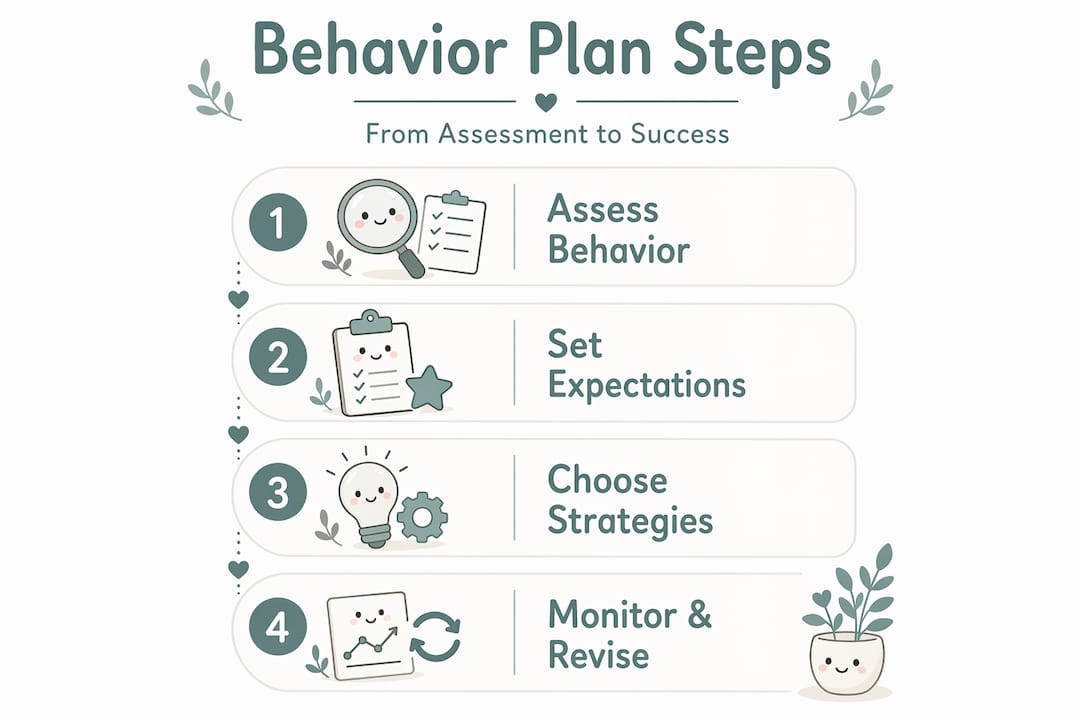
Here is a simple four-step monitoring process:
- Create a fidelity checklist that lists every component of the plan and asks whether each one was implemented that day. This takes two minutes to complete.
- Collect daily data on the target behavior, including frequency, duration, or intensity, depending on what you measured at baseline.
- Review data at the two-week mark with your team. Compare current data to baseline.
- Decide: continue, modify, or escalate. If behavior has not improved, the plan needs revision, not more time.
Only 33% of initial behavior support plans work without revisions. Fidelity checklists that track prevention strategies, replacement skill teaching, consequence delivery, and behavioral effects daily or weekly are what allow teams to evaluate and revise plans meaningfully after two to three weeks.
The comparison below shows what monitoring looks like with and without a fidelity checklist:
| Without fidelity checklist | With fidelity checklist |
|---|---|
| “The plan doesn’t seem to be working” | “We skipped the precorrection step 4 out of 5 days” |
| Blame falls on the student | Problem is identified in implementation |
| Plan is abandoned or escalated prematurely | Plan is revised based on specific gaps |
| No clear decision point | Two-week review triggers data-driven decision |
Pro Tip: Assign one person on the team to own the fidelity checklist each week. Shared responsibility often means no one does it. One owner, one checklist, one weekly review meeting keeps implementation on track.
Common pitfalls and pro tips for effective classroom behavior support plans
Knowing how to monitor your plan leads naturally to recognizing the mistakes that derail even well-designed plans.
Replacement behaviors must be in the student’s repertoire and naturally reinforced. If you select a replacement behavior the student cannot yet perform reliably, you have set everyone up to fail. Teach the replacement behavior explicitly, with prompting, before you expect the student to use it under pressure.
Here are the most common pitfalls in classroom behavior plan implementation:
- Removing task demands immediately after a behavior: This accidentally reinforces escape behavior. If a student throws materials and you immediately end the task, you have just taught them that throwing works.
- Overly complex plans: A plan with eight strategies and three data sheets will not be implemented consistently by a teacher managing 25 students. Simplicity is not a shortcut. It is a requirement.
- Skipping reinforcement thinning: Once a replacement behavior is established, gradually reduce how often you reinforce it. Immediate, constant reinforcement is a teaching phase tool, not a long-term plan.
- Using crisis procedures for non-dangerous behaviors: Reserve crisis thresholds for behaviors that pose a genuine safety risk. Overusing crisis protocols increases student stress and reduces their effectiveness when truly needed.
“Fidelity difficulties often cause plan failure; consistent implementation and regular reviews are the keys to avoid derailment.” — Watson Institute
Pro Tip: When a plan is not working, check fidelity before changing the plan. More often than not, the strategy is sound but the implementation has drifted. Fix the drift first.
A fresh perspective: Why simple, focused plans best support sensory regulation needs in classrooms
Here is something most professional development sessions will not tell you: the biggest predictor of whether a behavior support plan works is not the quality of the strategies. It is whether the teacher can actually implement it during a real school day.
Teachers managing classrooms with 20 to 30 students, multiple learning needs, and constant interruptions cannot execute an eight-step behavior plan with fidelity. The plan that gets implemented is the one that fits into the existing rhythm of the day. Simple plans focusing on one expectation, one routine, and one or two strategies over short periods prevent overwhelm and strengthen classroom supports effectively.
For students with sensory regulation needs specifically, simplicity is not just a convenience. It is a clinical necessity. These students often have nervous systems that are already working overtime to process the environment. Introducing a complex, unpredictable plan with multiple new demands adds cognitive and sensory load. A focused, predictable plan with clear routines and consistent sensory supports actually reduces the conditions that trigger the behavior in the first place.
Short-term plans with defined success criteria also build momentum. When a teacher sees measurable improvement in two weeks, they believe the plan is worth continuing. That belief drives consistent implementation, which drives better outcomes. It is a positive cycle that complexity breaks before it can start. Collaboration with occupational therapists and behavior specialists is most effective when it is used to simplify and sharpen a plan, not to add more components to it.
How Growing Balanced supports your classroom behavior plans
Building an effective classroom behavior plan takes the right tools alongside the right strategies.
Growing Balanced offers visual schedules and balanced routines designed specifically for teachers and therapists supporting children with sensory regulation needs. The platform’s OT-informed tools help you create predictable daily structures that reduce transition stress, support sensory regulation, and make behavior support plans easier to implement consistently. From printable sensory profiles to co-regulation scripts and routine templates, Growing Balanced gives you the practical resources to turn a well-designed behavior plan into a daily classroom reality. Explore the platform and see how it fits into the work you are already doing.
Frequently asked questions
What is a Functional Behavioral Assessment (FBA) and why is it important?
An FBA is a structured data collection process that identifies why a behavior occurs, so your support plan addresses the actual function rather than just the surface behavior. Data collection over 5 to 10 days gives you the foundation for a plan that actually works.
How many classroom expectations should I include in my behavior plan?
Limiting expectations to three to five clear, observable, positively stated behaviors makes them teachable and reinforceable within a busy classroom day.
How do I include sensory regulation needs in a behavior support plan?
Identify sensory functions during the FBA, then build in always-available sensory supports. Sensory strategies like fidget menus and visual timers address the underlying need rather than just managing the behavior after it occurs.
What should I do if my behavior support plan is not improving student behavior?
First, check your fidelity checklist to confirm the plan is being implemented as written. If no improvement appears after 2 to 3 weeks, revise the plan with your team using the data you have collected.
Why is positive feedback important in behavior support?
A high ratio of positive to corrective feedback builds trust, reinforces desired behaviors, and shifts the classroom dynamic in a measurable way. A 5:1 positive-to-correction ratio is the research-supported target for effective positive behavior supports.