
Sensory Regulation Tools for Home: A Parent's Guide
Discover effective sensory regulation tools for home that help your child self-regulate and find calm. Transform your environment today!
Sensory Regulation Tools for Home: A Parent’s Guide
TL;DR:
- Creating an effective sensory regulation system at home involves environmental adjustments, personalized tools, and proactive routines. Reassess and rotate tools regularly to ensure they remain effective as your child’s sensory needs evolve over time. Tailoring strategies to your child’s individual profile, with OT guidance, fosters better self-regulation and emotional well-being.
Sensory regulation tools for home are purposefully selected items and environmental adjustments designed to help children with sensory processing challenges calm their nervous systems and self-regulate effectively. In occupational therapy, this practice is formally called sensory modulation. The right combination of weighted blankets, noise-reducing headphones, fidget tools, and dimmable lighting can shift a child from overwhelm to calm far faster than redirection alone. Matching tools to your child’s individual sensory profile, rather than copying what works for another family, is what separates a functional system from a cluttered corner that nobody uses.
What are the best sensory regulation tools for home environments?
Before you order a single product, the environment itself needs attention. Emotional regulation begins with how a child experiences the entire home’s sensory input, not just what sits in a dedicated corner. Fluorescent overhead lighting, overlapping background noise from TVs and appliances, and visual clutter in high-traffic areas all increase the sensory load a child must manage before any tool can help.
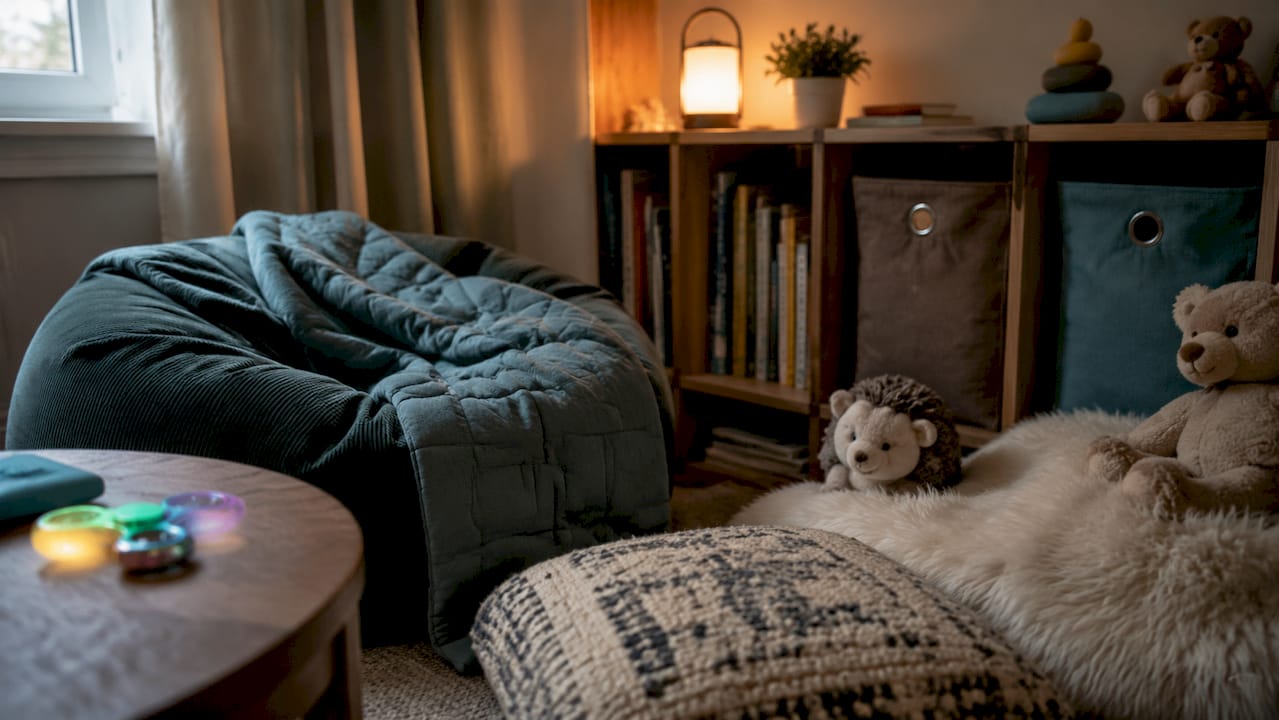
Start with three controllable variables: lighting, sound, and layout. Swap harsh overhead bulbs for warm, dimmable alternatives. Add soft furnishings like rugs, curtains, and upholstered seating to absorb sound rather than reflect it. Then choose a low-traffic location for your sensory space, ideally a quiet corner away from the kitchen or main living area.
A dedicated sensory space does not need to be large. An effective home sensory space needs only 4 to 6 square feet, with soft warm lighting and a curated set of age-appropriate tools. Visual boundaries matter as much as square footage. A small rug, a low bookshelf, or a canopy overhead signals to the child that this space has a specific, predictable purpose.
Pro Tip: Give your child some control over the space. A simple dimmer switch or a child-operated sound machine builds a sense of ownership that makes the space more likely to be used during actual moments of dysregulation.
Zoning the space into distinct areas, even within a small footprint, also improves function. Sensory spaces work best when designed as zoned participation areas with calm-down, movement, tactile exploration, and transition zones visually separated. A floor cushion for deep pressure, a small bin of tactile tools, and a visual timer on a shelf can each occupy a different zone without requiring a dedicated room.
How do you choose sensory tools matched to your child’s profile?
Sensory tools fall into four main categories, and the right choice depends entirely on whether your child is sensory seeking or sensory avoiding.
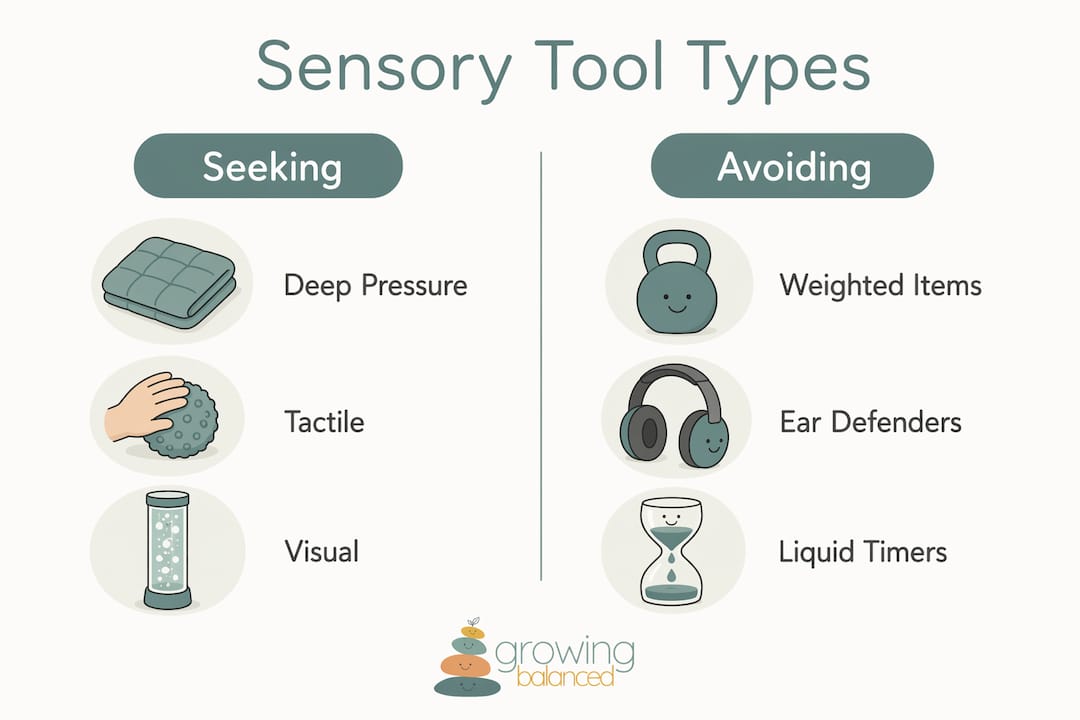
| Category | Sensory seeking tools | Sensory avoiding tools |
|---|---|---|
| Deep pressure | Weighted blanket, lap pad, compression vest | Light-touch fidgets, open seating |
| Auditory | White noise machine, music headphones | Ear defenders (up to 27.1 dB reduction) |
| Tactile | Kinetic sand, textured fidgets, therapy putty | Smooth, predictable textures only |
| Visual | LED color-changing lights, bubble timers | Dim, single-color lighting, minimal decor |
Weighted deep-pressure items, tactile tools, visual liquid timers, and ear defenders are commonly bundled in sensory comfort kits precisely because they address multiple sensory channels at once. That bundling works well as a starting point, but it is not a substitute for knowing your child’s profile.
Developmental stage also shapes tool selection. Toddlers respond best to soft textures, large-grip fidgets, and simple cause-and-effect tools like squeeze balls. School-age children can engage with resistance bands, sensory journals, and bubble timers that build self-awareness alongside regulation. Teenagers often prefer tools that look less clinical, such as stress cubes, weighted lap pads that double as blankets, or low-profile noise-canceling headphones.
Pro Tip: Rotate tools quarterly rather than leaving the same items out indefinitely. Novelty sustains engagement, and a tool that has lost its appeal will not be used when it matters most.
One caution: more tools do not mean better regulation. Simple, easy-to-reset sensory corners with few well-matched tools achieve better sustainability than elaborate, hard-to-maintain setups. Start with three to five items, observe what your child actually reaches for, and build from there. You can find guidance on organizing these choices into a portable format through Growingbalanced’s printable sensory toolkit resource.
How does a sensory diet work as a proactive home strategy?
A sensory diet is not a food plan. It is a personalized, OT-informed sensory activity schedule designed to keep a child in an optimal arousal zone for learning and self-regulation throughout the day. It incorporates proprioceptive, tactile, and vestibular inputs tailored to whether the child is over-responsive or under-responsive to sensory input.
The most important principle of a sensory diet is timing. Sensory diet plans should be preventive, scheduled before challenging moments rather than deployed only during meltdowns. Here is how to build that into a daily structure:
- Identify high-stress transition points. Morning routines, school pickup, and bedtime are the most common triggers. Schedule sensory input 10 to 15 minutes before each one.
- Pair sensory activities with existing routines. A five-minute session on a mini trampoline before homework, or a weighted blanket during story time, adds sensory input without creating a separate task.
- Use visual schedules to signal the plan. Children regulate better when they can predict what comes next. A visual schedule that includes sensory breaks reduces resistance and increases cooperation.
- Collaborate with an occupational therapist. An OT can assess your child’s sensory profile formally and adjust the diet as needs change. Ayres Sensory Integration therapy shows RCT-level evidence for improvements in emotional coping, impulse control, and independence in children with ADHD. That evidence base supports building your home program on OT principles. Growingbalanced’s OT home program guide explains how to structure this at home.
- Track what works and adjust every few weeks. A simple log noting the time, activity, and your child’s response before and after gives you real data to share with your OT.
How to adapt your sensory space as your child grows
A sensory setup that works at age five will likely need significant changes by age eight. Sensory profiles shift with development, and tools that once provided the right input can become either too stimulating or too boring.
- Reassess every 6 to 12 months. Schedule a brief review of which tools your child still uses, which have been ignored for more than a month, and whether the space layout still fits their body size and preferences.
- Rotate tools quarterly to prevent habituation. A weighted blanket that has been used daily for a year may no longer provide the same calming effect. Swapping it out temporarily and reintroducing it later often restores its effectiveness.
- Adjust physical dimensions as your child grows. A floor cushion sized for a five-year-old will not provide the same deep pressure for a ten-year-old. Tool sizing matters for proprioceptive input to work correctly.
- Document what works in writing. A short note after each sensory session, even just a few words, builds a record that helps you spot patterns and communicate clearly with therapists or teachers.
- Keep the space easy to reset. Control and predictability of the sensory space matter more than the quantity of tools. If the space takes more than two minutes to tidy, it will not stay organized, and a disorganized space loses its regulatory function quickly.
Individualized sensory profiles combined with predictable spaces and consistent routines yield the best regulation results over time. The goal is a living system that grows with your child, not a one-time setup.
What I’ve learned from watching families build sensory spaces at home
The families I see make the most progress are not the ones with the most tools. They are the ones who started with the environment before they bought anything. Fixing the lighting and reducing background noise, sometimes as simply as adding a low-noise air purifier to reduce ambient hum, consistently outperforms adding a new product to an already overwhelming space.
The second thing I have noticed is that children regulate faster when they chose the tools themselves. Giving a child two or three options and letting them pick what goes in their corner builds the kind of emotional ownership that makes the space actually work during hard moments. A corner a child helped design gets used. One that was set up for them often gets ignored.
My honest advice: resist the urge to replicate what you see in therapy clinic photos. Sensory modulation strategies must be individual. A sound that calms one child might distress another. Start small, observe carefully, and trust the data your child gives you through their behavior. Patience and iteration are not signs that you are doing it wrong. They are the method.
— Kelsey
How Growingbalanced supports your home sensory regulation plan
Building a sensory regulation system at home takes more than the right tools. It takes structure, consistency, and a way to track what actually works for your child.
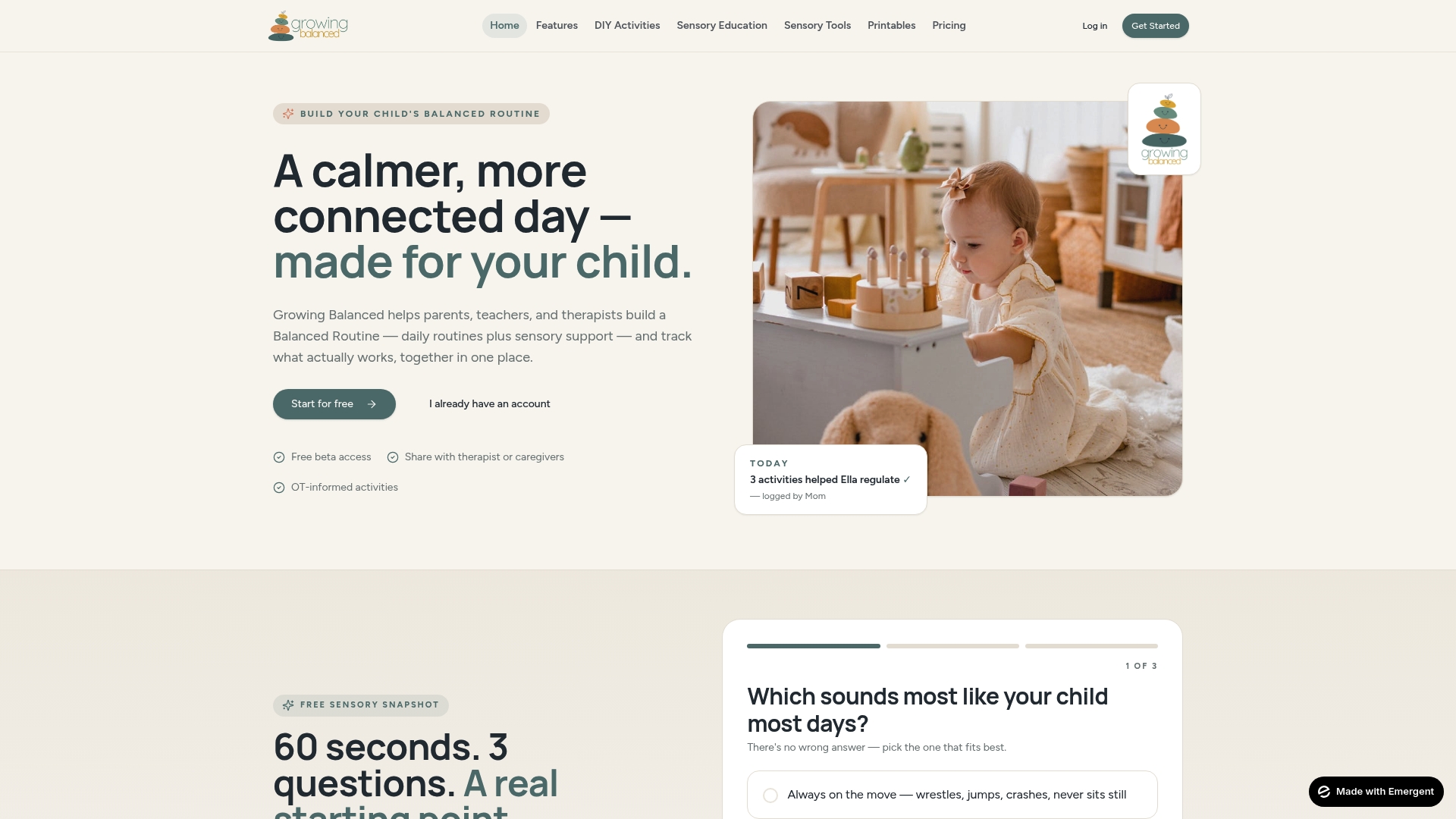
Growingbalanced is an OT-informed digital platform built specifically for parents and caregivers managing children’s sensory and self-regulation needs. Its daily visual schedules and sensory routines integrate directly with sensory diet planning, giving your child a predictable visual structure that supports every tool and strategy covered in this article. The platform includes sensory activity suggestions, printable resources, co-regulation scripts, and sensory profiles you can share with your child’s OT or teacher. For families who want a practical, organized system rather than a collection of disconnected strategies, Growingbalanced brings it all into one place.
FAQ
What are sensory regulation tools for home?
Sensory regulation tools for home are physical items and environmental modifications, such as weighted blankets, fidget tools, noise-canceling headphones, and dimmable lighting, selected to help children with sensory processing challenges calm their nervous systems and self-regulate.
How do I create a sensory space at home?
Choose a low-traffic corner of 4 to 6 square feet, use warm dimmable lighting, add soft furnishings to absorb sound, and stock it with three to five tools matched to your child’s sensory profile. Visual boundaries like a rug or canopy help signal the space’s purpose.
What is a sensory diet and how does it work at home?
A sensory diet is a scheduled, OT-informed plan of sensory activities timed throughout the day to keep a child in an optimal arousal state. It works best when used proactively before high-stress transitions rather than only during dysregulation.
How often should I update my child’s sensory tools and space?
Reassess your child’s sensory space and tool selection every 6 to 12 months, and rotate individual tools quarterly to prevent habituation and maintain their regulatory effectiveness.
Do sensory tools work the same for every child?
No. Sensory modulation is individual. A tool or sound environment that calms one child may increase distress in another, which is why matching tools to each child’s specific sensory profile, ideally with OT guidance, produces the most consistent results.
Recommended
- Home program components: OT recommendations for sensory kids · Growing Balanced Blog
- Sensory Tools in Classrooms: What Educators Need to Know · Growing Balanced Blog
- Create Printable Sensory Toolkit for Your Child · Growing Balanced Blog
- Ayres Sensory Integration Explained for Parents · Growing Balanced Blog