
Ayres Sensory Integration Explained for Parents
Discover how Ayres sensory integration explained can transform your understanding of your child's behavior and promote positive experiences at home.
Ayres Sensory Integration Explained for Parents
TL;DR:
- Sensory processing difficulties are often misunderstood as behavioral issues when they are actually neurological responses to overwhelming stimuli. Ayres sensory integration theory emphasizes organizing sensory input from vestibular, proprioceptive, and tactile systems to improve brain function through structured, playful therapy. Consistent implementation of sensory diets and environmental adjustments at home and school can help children regulate emotions and enhance learning, with progress influenced by neuroplasticity and parental support.
Your child covers their ears at birthday parties, refuses to wear certain fabrics, or melts down after a busy school day. Before you understood sensory processing, you probably wondered what you were doing wrong. With Ayres sensory integration explained clearly, that confusion starts to lift. Dr. A. Jean Ayres gave us a neurological framework that reframes your child’s behavior not as defiance, but as a brain that is working hard to process a world that feels overwhelming. This article walks you through the theory, the therapy, and what you can actually do at home.
Table of Contents
- Ayres sensory integration explained: the neurological foundation
- How sensory integration therapy actually works
- Key concepts every parent should understand
- Supporting your child at home and school
- My take on what actually changes things
- Build daily routines that support sensory regulation
- FAQ
Ayres sensory integration explained: the neurological foundation
Ayres Sensory Integration (ASI) is the neurological process of organizing sensory input from the body and environment so the brain can use it effectively. Dr. A. Jean Ayres, an occupational therapist and neuroscientist, introduced this theory in 1972 in her book Sensory Integration and Learning Disorders. Her core argument was that the brain needs to receive, sort, and connect information from multiple senses before a child can respond appropriately to the world around them.
Think of the brain as an air traffic control tower. When every incoming signal gets routed correctly, planes land smoothly. When the routing system is off, you get delays, confusion, and collisions. For children with sensory processing differences, that routing system needs extra support.
Ayres Sensory Integration theory focuses on three sensory systems that most people do not think about:
- Vestibular system: Located in the inner ear, it processes movement and balance. A child who seeks constant spinning or crashes into furniture may have a vestibular processing difference.
- Proprioceptive system: Receptors in muscles and joints tell the brain where the body is in space. Children who push, pull, or squeeze things constantly are often seeking proprioceptive input.
- Tactile system: Skin receptors process touch. Sensitivity here explains why certain clothing textures feel unbearable or why light touch feels threatening.
Neuroplasticity enables the brain to form new neural pathways during childhood when given structured sensory experiences. This is the biological reason ASI therapy works. The younger the child, the more the brain can adapt, though meaningful change is possible at any age.
Pro Tip: If your child’s behaviors seem inconsistent, track them in relation to sensory events like loud environments, clothing changes, or physical activity. Patterns often reveal the specific sensory systems involved.
How sensory integration therapy actually works
Knowing the theory is one thing. Watching it in practice is where it clicks for most parents. Sensory Integration Therapy uses structured, playful activities targeting the vestibular, proprioceptive, and tactile systems to improve how the brain processes input. The setting matters as much as the activities. A certified occupational therapist works in a sensory-enriched space filled with swings, climbing structures, weighted tools, and textured materials.
Here is what a typical therapy process looks like from start to finish:
- Assessment: The therapist uses standardized tools like the Sensory Processing Measure (SPM) and Sensory Integration and Praxis Tests (SIPT) to understand how your child processes sensory information. This is not guesswork. It is a structured evaluation that shapes every decision that follows.
- Sensory diet creation: Based on the assessment, the therapist builds a personalized plan of daily sensory activities designed to keep your child regulated throughout the day.
- Therapy sessions: Sessions typically last 45 to 60 minutes, one to three times a week. The child leads the play, but the therapist guides the challenge level continuously, keeping the child in their optimal learning zone.
- Caregiver training: You are not a bystander. The therapist teaches you how to carry the sensory diet into daily routines at home and school.
- Progress review: Goals are reassessed regularly and the plan adjusts as your child develops new skills.
The activities themselves look like play, and that is intentional. Swinging activates the vestibular system. Carrying a heavy backpack or pushing a laundry cart provides proprioceptive input. Finger painting or playing with kinetic sand addresses tactile processing. Engaging children through play in sensory-rich environments promotes the neuroplastic changes that make improvements last.
Pro Tip: Ask any therapist you consider whether they hold ASI certification through the Sensory Integration Global Network. ASI certification indicates specialized training in Ayres’ original methods, which is distinct from general sensory activities.

Key concepts every parent should understand
A few terms come up repeatedly in ASI conversations. Understanding them helps you talk with therapists, advocate at school, and make sense of what you observe at home.
Praxis: the skill behind doing
Praxis in ASI includes ideation, motor planning, and execution, meaning the ability to think of an action, plan the steps, and carry it out. A child with poor praxis might struggle to figure out how to climb a new piece of playground equipment even though they are physically capable. It is not a coordination problem. It is a sensory processing problem that affects movement.
The sensory diet
A sensory diet is a personalized, daily schedule of sensory-regulating activities designed by an OT to help children maintain optimal arousal throughout the day. It includes heavy work, deep pressure, movement breaks, and predictable routines. The name is a metaphor. Just as your body needs food at regular intervals, your child’s nervous system needs specific sensory inputs at predictable times.
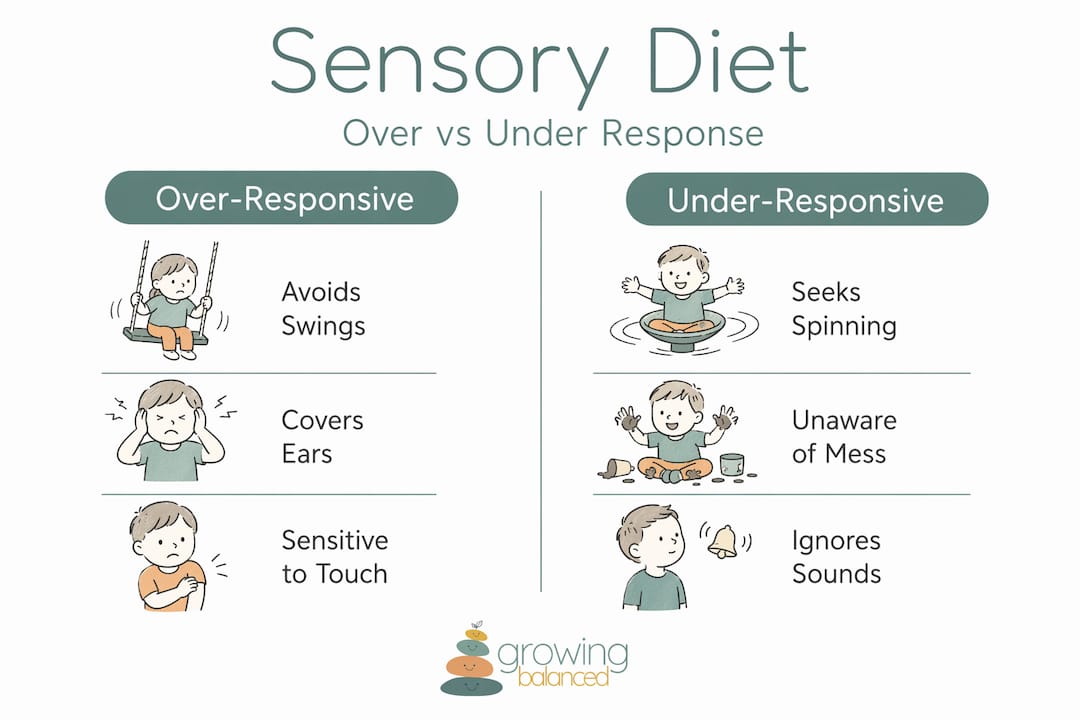
Here is a quick comparison of what each core sensory system looks like when it is over or under-responsive:
| Sensory system | Over-responsive signs | Under-responsive signs |
|---|---|---|
| Vestibular | Fear of swings, avoids movement | Constant spinning, craves fast movement |
| Proprioceptive | Dislikes being touched or hugged | Crashes into things, bites, chews non-food items |
| Tactile | Refuses certain textures, hates tags | Unaware of pain, touches everything constantly |
Recognizing where your child falls on this spectrum helps you and the therapist target the right activities and avoid accidentally triggering overload.
Supporting your child at home and school
Therapy is one hour a few times a week. The rest of your child’s life happens with you. That is why sensory challenges are often invisible barriers that require consistent support across every environment, not just the clinic.
Here are practical ways to apply ASI principles outside of therapy:
- Build a sensory-friendly environment. Reduce visual clutter, use soft lighting, and keep noise levels predictable. Small changes make a measurable difference in how regulated your child feels.
- Implement the sensory diet consistently. The sensory diet requires caregiver training and consistent implementation for best outcomes. Work with the therapist to build sensory breaks into morning routines, transitions, and after school wind-down time.
- Recognize overload before it peaks. Overload from noise, visual clutter, and tactile sensitivities can trigger shutdowns or meltdowns. Watch for early signs like covering ears, pulling at clothing, or increased irritability.
- Communicate with teachers. Share your child’s sensory profile and sensory diet with educators. A classroom behavior support plan that includes sensory accommodations keeps your child regulated during the school day.
- Use visual schedules. Predictability reduces sensory load. When your child knows what comes next, their nervous system spends less energy on uncertainty and more on learning.
For structured guidance on building sensory-informed home programs, look for resources specifically designed by occupational therapists rather than general parenting advice.
My take on what actually changes things
I have seen parents come in frustrated, convinced their child is just “difficult.” Once they understand Ayres sensory integration theory, something shifts. Not in the child right away, but in the parent. They stop reacting to the behavior and start reading it. That reframe changes everything.
What I have learned is that the families who see the most progress are not necessarily the ones with the most therapy hours. They are the ones who treat the sensory diet as a non-negotiable part of the day, the same way they treat meals and bedtime. Consistency is the actual therapy.
I also want to be honest: not every child responds the same way, and progress is rarely linear. Some weeks feel like breakthroughs. Others feel like you are starting over. The key is to keep viewing your child’s behavior as communication, not opposition. When you see a meltdown as a sensory system that got overwhelmed rather than a child choosing to be difficult, you respond with curiosity instead of frustration. That response, repeated over time, is what builds trust and regulation together.
Seek out a neurodiversity-affirming OT who respects your child’s experience and involves you in every step. You are not just a caregiver in this process. You are the most important part of it.
— Kelsey
Build daily routines that support sensory regulation
Understanding ASI is the first step. Putting it into practice every single day is where the real work happens, and you do not have to figure it out alone.
Growingbalanced offers visual scheduling tools, sensory activity suggestions, and OT-informed resources designed specifically for parents and caregivers of children with sensory processing challenges. Whether you are building a morning routine that reduces meltdowns or creating a sensory break schedule for school, the daily visual schedules and routines at Growingbalanced give you a practical starting point grounded in occupational therapy principles. Predictable routines lower sensory load, support emotional regulation, and make the strategies your child’s therapist recommends easier to carry into real life.
FAQ
What is Ayres Sensory Integration?
Ayres Sensory Integration is a neurological theory and therapy framework developed by Dr. A. Jean Ayres in the 1970s that explains how the brain organizes sensory input from the body and environment to support behavior, learning, and emotional regulation.
How does sensory integration therapy work?
A certified occupational therapist uses structured, playful activities targeting the vestibular, proprioceptive, and tactile systems to help the brain process sensory input more effectively, with sessions typically lasting 45 to 60 minutes one to three times a week.
What is a sensory diet?
A sensory diet is a personalized daily schedule of sensory-regulating activities created by an OT, including heavy work, deep pressure, and movement breaks, designed to help children maintain a calm and focused state throughout the day.
How do I know if my child needs sensory integration support?
Signs include strong reactions to textures, sounds, or movement, frequent meltdowns in busy environments, difficulty with transitions, and behaviors that look like defiance but seem tied to specific sensory situations rather than deliberate choices.
Can parents support sensory integration at home?
Yes. Implementing a consistent sensory diet, creating a predictable environment, using visual schedules, and communicating your child’s sensory needs to teachers all extend the benefits of therapy into daily life.
Recommended
- Neurodiversity-affirming OT: a complete parent’s guide · Growing Balanced Blog
- Home program components: OT recommendations for sensory kids · Growing Balanced Blog
- Growing Balanced — daily visual schedules & balanced routines
- How to build a behavior support plan for your classroom · Growing Balanced Blog