
How to Write Sensory Goals in an IEP Document
Learn how to write sensory goals in an IEP document using the SMART framework. Ensure your child's success with clear objectives that work.

How to Write Sensory Goals in an IEP Document
TL;DR:
- Effective sensory goals in an IEP are specific, measurable, relevant, achievable, and time-bound, focusing on supporting learning rather than medical diagnosis. Incorporating sensory diets and accommodations grounded in OT evaluations ensures goals are tailored to each child’s unique sensory profile and legal requirements. Clear, action-oriented language with structured support and collaboration enables meaningful progress and accountability.
Sensory goals in an IEP document are specific, measurable objectives that address how a child’s sensory regulation needs affect their ability to learn and participate in school. Writing these goals correctly requires more than good intentions. It requires a structured approach grounded in the SMART framework, occupational therapy (OT) evaluations, and a clear understanding of what “functional” means in an educational setting. When done well, sensory IEP documentation creates legal accountability, guides daily instruction, and gives children the support they actually need to succeed.
What are the key components of effective sensory goals in an IEP?
The SMART framework is the standard structure for writing IEP goals, and sensory goals are no exception. SMART stands for Specific, Measurable, Achievable, Relevant, and Time-bound. Each element shapes how a goal is written and whether it holds up in practice.

Specificity means linking the goal to an observable sensory behavior. “Will improve behavior” fails. “Will use a movement break to return to a regulated state within 5 minutes” succeeds. The behavior, the support, and the expected outcome must all be named.
Measurability requires observable criteria and a data collection method. Common metrics include success in 3–4 of 5 observed instances weekly. That kind of standard gives teachers and therapists a clear benchmark to track.
Achievability means setting a realistic success rate. Most IEP goals target 75–85% accuracy or frequency. That range accounts for the natural variability of a school environment without setting a child up to fail.
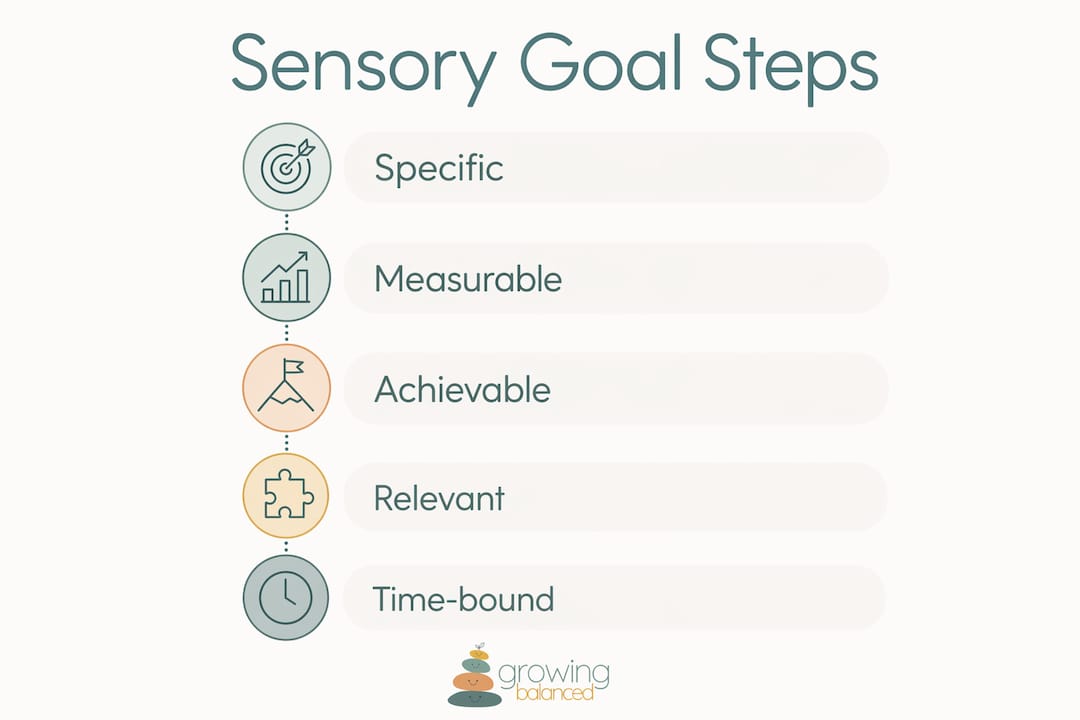
Relevance is where many teams go wrong. A sensory goal must connect to educational performance, not a medical diagnosis. The goal is not to “fix” sensory processing. The goal is to help the child access learning.
Time-bound elements anchor the goal to a review cycle. Most IEPs review goals annually, but sensory goals benefit from quarterly check-ins tied to the sensory diet schedule.
- Specify the sensory behavior and the support provided
- Define success using observable, countable criteria
- Set a 75–85% success rate to allow for real-world variability
- Connect the goal to a classroom activity or educational outcome
- Include a review deadline and data collection method
Pro Tip: Write the goal’s condition first. “Given access to a fidget tool and a quiet workspace, the student will…” sets up accountability before the expectation is even stated.
How to incorporate sensory diets and accommodations into IEP sensory goals
A sensory diet is an individualized schedule of sensory activities designed to help a child maintain a regulated state throughout the day. Sensory diets are not one-size-fits-all. They are built from OT evaluations and reflect each child’s unique sensory profile. Understanding why a sensory diet supports IEP goals is straightforward: it provides the daily input a child needs to stay available for learning.
OT evaluations are the starting point for identifying which accommodations belong in the IEP. Without a thorough assessment, teams are guessing. With one, they can name specific tools and strategies with confidence.
Common sensory accommodations documented in IEPs include:
| Accommodation | Purpose | When to use |
|---|---|---|
| Noise-canceling headphones | Reduce auditory overload | During loud transitions or group work |
| Movement breaks | Provide proprioceptive input | Every 45–60 minutes or before focused tasks |
| Flexible seating | Support postural regulation | Throughout the school day |
| Quiet workspace | Limit sensory distractions | During assessments or independent work |
| Weighted lap pad | Provide deep pressure input | During seated tasks requiring focus |
Sensory accommodations are legally mandated supplementary aids under IDEA and must be documented in the IEP to guarantee a Free Appropriate Public Education (FAPE). That legal weight matters. It means a school cannot simply skip the movement break because the schedule is tight.
Embed accommodations directly into the goal’s language. “Given access to noise-canceling headphones during group instruction” is not just a description. It is a legal obligation written into the goal itself. For a broader look at what belongs in a classroom, Growingbalanced’s guide on sensory tools in classrooms covers the full range of options educators can draw from.
What are examples of measurable sensory goals and common pitfalls to avoid?
Clear examples make the difference between a goal that guides practice and one that sits unused in a binder. Here are three models that reflect strong sensory IEP documentation:
- Self-regulation during transitions: “Given a visual schedule and a 2-minute warning, the student will transition between activities within 3 minutes without physical escalation in 4 of 5 observed opportunities over 8 weeks.”
- Sensory self-advocacy: “Given instruction in sensory language, the student will independently request a movement break or sensory tool before reaching a dysregulated state in 3 of 4 school days per week over one grading period.”
- Sustained attention with supports: “Given access to flexible seating and a fidget tool, the student will remain on task during a 20-minute independent work period in 80% of observed sessions over 10 weeks.”
Each goal names the condition, the behavior, the criteria, and the timeline. That structure is what makes a goal enforceable. Without explicit supports written into the goal, a school cannot be held accountable if those supports are missing.
Common pitfalls to avoid:
| Weak goal | Strong alternative |
|---|---|
| “Will handle transitions better” | “Will transition within 3 minutes of a verbal cue in 4 of 5 trials” |
| “Will reduce sensory meltdowns” | “Will use a calming strategy independently before escalation in 80% of opportunities” |
| “Will improve focus” | “Will sustain attention for 20 minutes with fidget support in 80% of sessions” |
Strong IEP goals avoid targeting harmless behaviors like stimming or eye contact. The focus belongs on self-advocacy and functional participation, not on making a neurodivergent child appear more neurotypical.
Pro Tip: Use shared sensory language across home and school. When caregivers and teachers use the same words for sensory states, children learn to self-identify and communicate their needs far more reliably.
How to collaborate with IEP team members to write and implement sensory goals
Writing sensory goals is a team process. The occupational therapist brings assessment data and clinical knowledge. The classroom teacher brings daily observation. Caregivers bring knowledge of the whole child. Each perspective is necessary for a goal that actually works.
Parents hold legal rights under IDEA to propose IEP goals. If a school rejects a proposed goal, they must issue a Prior Written Notice (PWN) explaining the refusal. That document creates an official record and supports future advocacy. Knowing this shifts the dynamic in IEP meetings. You are not asking for permission. You are exercising a right.
Practical steps for effective collaboration:
- Bring OT evaluation results and a written draft of proposed goals to the meeting
- Ask the team to explain how each goal will be measured and by whom
- Request a copy of the data collection method before the meeting ends
- Schedule a mid-year check-in rather than waiting for the annual review
- Use the PWN process if any accommodation or goal is denied without explanation
Growingbalanced’s resource on neurodiversity-affirming OT gives caregivers a strong foundation for these conversations, particularly when advocating for goals that center the child’s strengths.
Troubleshooting common challenges when writing sensory goals for IEPs
Vague goals are the most common problem in sensory IEP documentation. A goal like “will handle sensory input better” cannot be measured, cannot be enforced, and cannot guide instruction. Rewriting it requires adding a condition, a behavior, a criterion, and a timeline.
When goals are not producing results, check these areas first:
- No baseline data: Goals written without current performance data have no starting point. Request an OT evaluation or classroom observation before the next IEP meeting.
- Generic templates: A goal copied from a database may not reflect the child’s actual sensory profile. Every goal should trace back to assessment findings.
- Inconsistent implementation: A movement break that only happens when a teacher remembers is not a support. Document the frequency and timing explicitly.
- Suppression-focused language: Goals that aim to eliminate a behavior without addressing the underlying sensory need create stress, not regulation.
“The goal is not to make a child fit the classroom. The goal is to make the classroom work for the child.”
Functional IEP goals focus on what the student will do more independently in daily life. That framing keeps the team focused on real outcomes rather than compliance checkboxes. For a deeper look at building a complete sensory support plan, Growingbalanced’s guide on home program components offers OT-informed strategies that translate directly into IEP goal language.
What I’ve learned from years of working with sensory IEP goals
The most meaningful sensory goals I have seen share one quality: they are written for the child in front of you, not for a template. Teams that spend time understanding a child’s sensory profile before the meeting write goals that actually get implemented. Teams that arrive with a generic list often leave with goals that collect dust.
The shift toward neurodiversity-affirming language is not just ethical. It produces better outcomes. When a goal builds a child’s ability to recognize and communicate their sensory state, that skill transfers across every setting. When a goal tries to eliminate stimming, it creates anxiety and erodes trust.
IEPs are living documents. A sensory goal that made sense in September may need adjustment by January. Build that expectation into the process from the start. Request data reviews, stay in contact with the OT, and treat every meeting as a chance to refine rather than defend.
— Kelsey
How Growingbalanced supports sensory goal planning and daily routines
Translating IEP sensory goals into daily practice is where most families and educators hit a wall. Growingbalanced is built specifically for that gap.
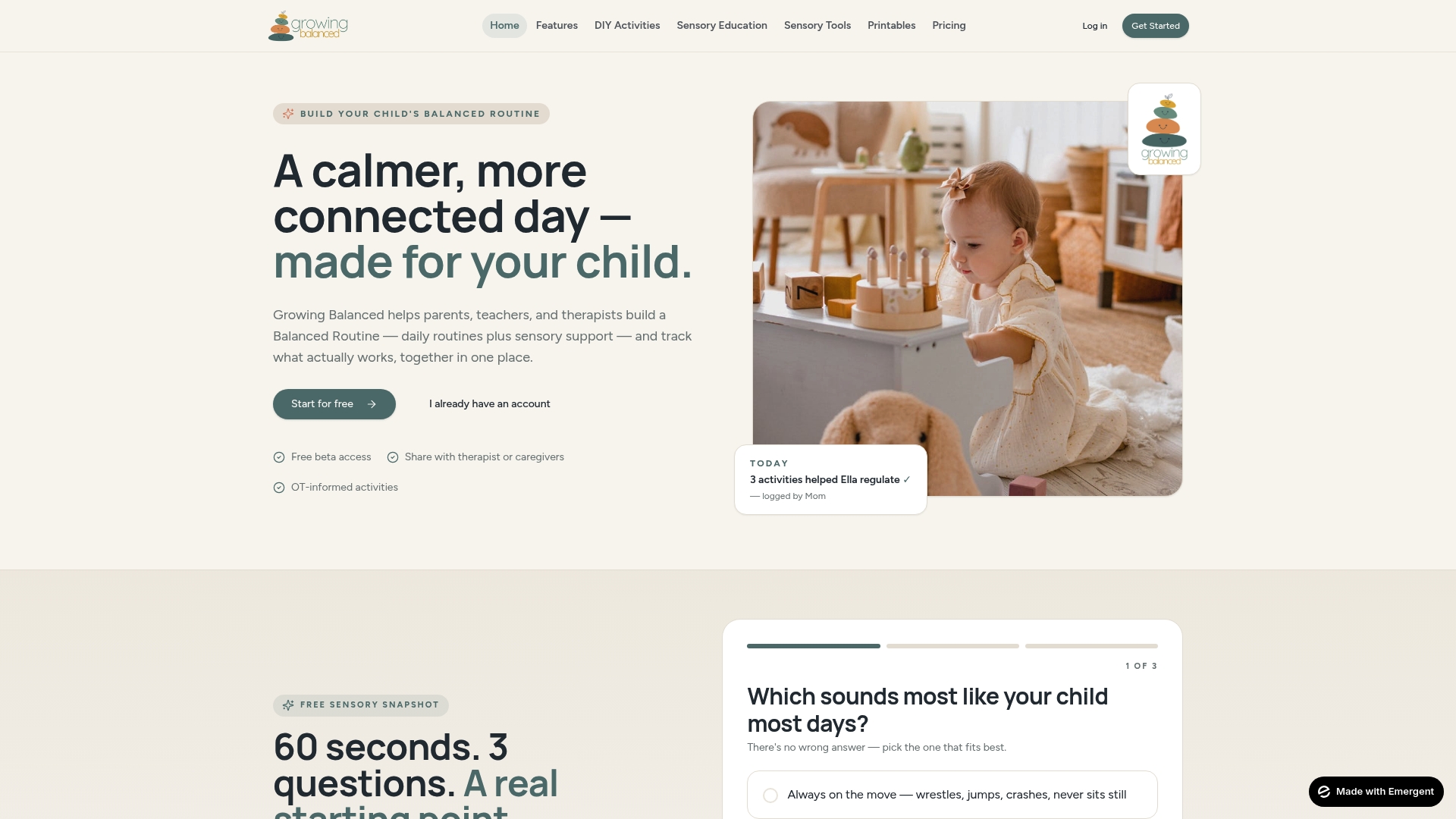
The platform offers visual scheduling tools, sensory activity suggestions, and printable resources grounded in occupational therapy. These tools help caregivers and teachers build the consistent daily routines that make sensory goals achievable, not just documented. Whether you are setting up a morning routine at home or planning classroom transitions, Growingbalanced gives you the structure to make it work. Explore daily visual schedules and balanced routines to find resources designed for exactly the children you are supporting.
FAQ
What does a sensory goal in an IEP look like?
A sensory goal names a specific behavior, the support provided, a measurable success rate, and a timeline. For example: “Given access to a movement break every 45 minutes, the student will return to a regulated state within 5 minutes in 4 of 5 observed opportunities over 8 weeks.”
How is a sensory diet different from a sensory goal?
A sensory diet is an individualized schedule of sensory activities that supports regulation throughout the day. A sensory goal is the measurable IEP objective the diet helps the child achieve. The diet is the strategy; the goal is the outcome.
Can parents propose their own sensory goals for an IEP?
Yes. Under IDEA, parents can propose goals, and if the school rejects them, it must issue a Prior Written Notice explaining why. That notice creates a legal record supporting further advocacy.
What success rate should sensory IEP goals target?
Most IEP goals target a 75–85% success rate. That range reflects realistic school conditions while still setting a meaningful standard for progress.
Why does sensory goal language matter so much?
Vague language makes goals unenforceable. Measurable alternatives that specify timing, prompts, and success rates give teachers clear guidance and give families a basis for accountability.
Recommended
- Home program components: OT recommendations for sensory kids · Growing Balanced Blog
- Ayres Sensory Integration Explained for Parents · Growing Balanced Blog
- Types of Sensory Accommodations in the Classroom: 2026 Guide · Growing Balanced Blog
- Sensory Processing and Handwriting Explained for Parents · Growing Balanced Blog