
Sensory Seeking Behavior Explained for Parents
Discover sensory seeking behavior explained: understand your child's needs, support their regulation, and enhance their well-being.

Sensory Seeking Behavior Explained for Parents
TL;DR:
- Sensory seeking behavior is a neurological need where children pursue more sensory input to regulate their nervous system. It often occurs in children with autism, ADHD, or sensory processing challenges and can be mistaken for attention-seeking or misbehavior. Supporting these children involves personalized sensory diets and activities that safely meet their sensory needs, improving focus and participation.
If your child constantly crashes into furniture, stuffs things in their mouth, or can’t seem to sit still no matter what you try, you’ve probably wondered what’s actually going on. Sensory seeking behavior explained simply: it’s a neurological drive to get more sensory input than the nervous system is currently processing. This isn’t defiance, and it isn’t a parenting failure. Understanding sensory seeking is the first step toward responding in a way that actually helps your child regulate, focus, and feel safe in their own body.
Table of Contents
- What is sensory seeking behavior and why it happens
- Common types of sensory seeking behaviors in children
- How to tell sensory seeking apart from attention-seeking
- Practical strategies to support sensory seeking children
- My honest take on how we respond to these kids
- Build a sensory routine that actually sticks
- FAQ
What is sensory seeking behavior and why it happens
Sensory seeking is a recognized neurological need in which a child’s nervous system is under-responsive, meaning it requires more sensory input than typical to reach a regulated, alert state. Think of it as a thermostat set too low. The child’s brain keeps signaling “more input, more input” because it hasn’t received enough to feel balanced.
This pattern is most commonly associated with autism and ADHD, but it can appear in children across a wide range of developmental profiles. The key word here is craving. These children aren’t choosing to climb the walls or lick objects to annoy you. Their nervous system is running a deficit, and their body is trying to fill it.
Sensory seeking is also distinct from sensory avoidance, the opposite pattern where a child pulls away from stimulation rather than pursuing it. Some children show both seeking and avoiding depending on the sensory channel, which makes their behavior look inconsistent and confusing to the adults around them.
Key things to understand about the neurological basis:
- Under-responsiveness means the brain processes sensory signals with less intensity than typical
- The child must seek MORE input to feel what most people feel at baseline
- Sensory input supports alertness and focus, not merely preference or habit
- Common conditions include autism, ADHD, sensory processing disorder, and developmental coordination disorder
Pro Tip: Simply stopping a sensory seeking behavior without offering a replacement almost never works. The physiological need stays unmet, so the behavior returns within minutes. Always swap, don’t just stop.
Common types of sensory seeking behaviors in children
Not all sensory seeking looks the same. Children seek input through different sensory channels, and the behaviors they show depend on which system is under-responsive.
| Sensory System | What it Regulates | Common Seeking Behaviors |
|---|---|---|
| Proprioceptive | Body position and muscle feedback | Crashing, pushing, heavy lifting, tight hugs |
| Vestibular | Balance and movement | Spinning, swinging, rocking, jumping |
| Tactile | Touch and texture | Mouthing objects, rubbing surfaces, touching everything |
| Auditory | Sound processing | Humming, yelling, making repetitive noises |
| Visual | Visual stimulation | Staring at lights, flicking fingers near eyes |
| Olfactory/Gustatory | Smell and taste | Sniffing people or objects, chewing non-food items |
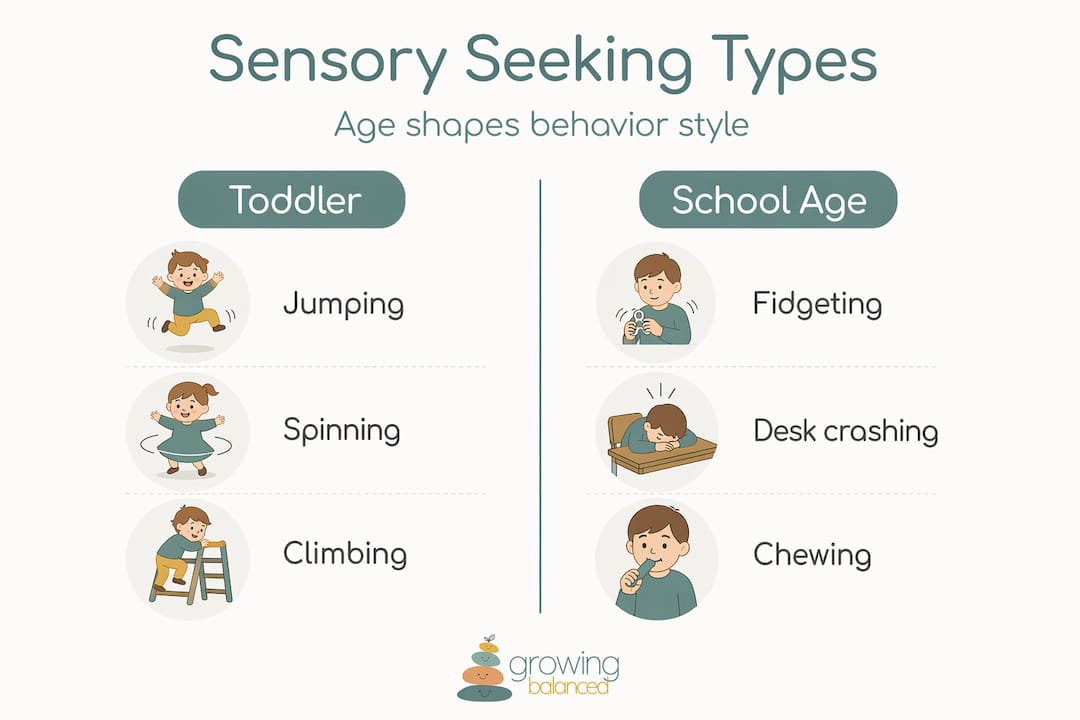
Frequent jumping, crashing, and spinning are among the most common behaviors reported across age groups because proprioceptive and vestibular input are powerful regulators for the nervous system.

Age shapes how these behaviors look. A toddler might hurl themselves off the couch repeatedly. A school-age child might tap their desk constantly, chew their pencil, or seek rough-and-tumble play far beyond what peers seem to want. A teenager might listen to music at high volume, seek out intense physical activity, or fidget throughout class in ways that disrupt their own learning.
One detail caregivers often miss: a child can seek input in one channel while avoiding it in another. A child may crave deep pressure while becoming distressed by loud sounds. This is a complex sensory profile, not contradictory behavior. Recognizing this nuance changes how you respond and what strategies you try first.
How to tell sensory seeking apart from attention-seeking
This is one of the most common questions parents and teachers ask, and the answer matters because the response is completely different for each.
Sensory seeking persists even without social attention, while attention-seeking behavior typically stops once the child gets the audience they were looking for. If your child keeps spinning in circles even after everyone in the room has walked away and stopped reacting, that’s a sensory need. If the behavior immediately stops when you engage with them, attention is more likely the driver.
Practical clues to watch for:
- The behavior happens when the child is alone as often as when others are present
- The child looks absorbed or self-focused during the behavior, not checking for reactions
- Ignoring the behavior doesn’t stop it. It continues regardless of your response
- The behavior intensifies in environments with low stimulation (quiet classrooms, bedtime)
- The child seems genuinely unaware they’re doing it
Mislabeling sensory seeking as misbehavior leads to discipline responses that don’t work and damage trust. A child who gets repeatedly punished for behavior they can’t control learns that adults are unsafe, not that they need to behave differently. Educators especially benefit from understanding how to build a behavior support plan that distinguishes these motivations before applying consequences.
Pro Tip: If you’re unsure whether a behavior is sensory or attention-driven, try providing the sensory input proactively before the behavior escalates. If the behavior reduces, you’ve identified a sensory need.
Practical strategies to support sensory seeking children
The goal is never to eliminate sensory seeking. OT interventions redirect sensory seeking into purposeful, appropriate forms that meet the child’s needs without disrupting learning or safety. Here’s how to build that support framework:
Start with a sensory diet. This is a personalized schedule of sensory activities that a child receives throughout the day to stay regulated. Occupational therapy uses sensory diets with specific activities like wall pushes, trampoline time, and weighted lap pads to help children maintain a regulated state from morning to bedtime.
Steps to implement a basic sensory support plan:
- Identify which sensory channels your child seeks most (use the table above as a guide)
- Build 3 to 5 sensory “input breaks” into the daily schedule at predictable times
- Select one or two activities per break that target the seeking pattern you observe
- Apply the plan consistently across home AND school, since consistency is what makes sensory diets effective
- Consult an occupational therapist to refine the plan based on a formal sensory profile
Specific activities worth trying by sensory type:
- Proprioceptive: carrying groceries, animal walks, wall push-ups, wearing a weighted vest
- Vestibular: swinging, rocking chairs, balance boards, movement breaks between tasks
- Tactile: playdough, sensory bins, brushing protocols under OT guidance
For toddlers specifically, creating safe “yes spaces” with floor cushions, crash pads, and soft climbing structures gives them an appropriate outlet rather than turning every piece of furniture into a crash zone. You can learn more about building these supports through OT home program recommendations designed specifically for sensory kids.
Pro Tip: Always consult a licensed occupational therapist before introducing deep pressure techniques like brushing or compression. These require specific training to apply safely and effectively.
My honest take on how we respond to these kids
I’ve seen the same pattern repeat itself across too many classrooms and too many family conversations. A child is crashing into things, making noise, touching everything in reach. The adult response is a warning, then a consequence, then frustration all around. Nothing changes. What I’ve learned is that we skip past understanding far too fast.
In my experience, the families and teachers who make the most progress are the ones who stop asking “how do I stop this behavior?” and start asking “what is this behavior telling me?” That shift is not soft or permissive. It’s more precise. When you know a child is seeking proprioceptive input because their nervous system demands it, you can give them something that actually works instead of something that just communicates disappointment.
What I find most encouraging is that consistent sensory diets improve focus and participation measurably and often quickly. This isn’t a years-long intervention before you see anything. Many families notice a difference within weeks of applying a structured sensory plan. If you’re burned out from trying the same corrections and getting nowhere, this is worth your time. Resources like Ayres Sensory Integration explained give you the theoretical grounding that makes all of this make sense.
— Kelsey
Build a sensory routine that actually sticks
Understanding the “why” behind sensory seeking is powerful. Translating it into a daily plan is where real change happens.

Growingbalanced is built for exactly this. The platform gives parents, educators, and therapists the tools to create personalized visual schedules and sensory support plans grounded in occupational therapy principles. You can map out movement breaks, schedule sensory activities at the right times of day, and share the plan across home and school so everyone is working from the same page. Whether you’re just starting to explore daily routines for sensory kids or you need a more structured sensory profile tool, Growingbalanced has the resources to move from understanding to action. Because knowing what sensory seeking is matters far less than having a practical, consistent plan in place.
FAQ
What is sensory seeking behavior in children?
Sensory seeking behavior is a neurological pattern in which a child actively pursues more sensory stimulation than typical to regulate their nervous system. It is most common in children with autism, ADHD, or sensory processing challenges.
How is sensory seeking different from attention-seeking?
Sensory seeking persists even when no one is watching or reacting, while attention-seeking behavior stops once the child receives social attention. Observing whether the behavior continues when the child is alone is the most reliable way to tell them apart.
What types of sensory seeking behaviors are most common?
The most commonly observed types involve proprioceptive and vestibular input, including jumping, crashing, spinning, and seeking deep pressure. Tactile seeking through mouthing objects or touching surfaces is also frequently reported.
Can a child seek sensory input in some ways and avoid it in others?
Yes. A child can crave deep pressure while being highly sensitive to loud sounds or certain textures. This overlapping sensory profile is common in children with autism and ADHD and requires a nuanced, individualized support approach.
When should I consult an occupational therapist about sensory seeking?
Consult an OT when sensory seeking behaviors are intense, frequent, difficult to interrupt, or interfering with daily routines and learning. A formal sensory profile from an OT provides the foundation for an effective, personalized sensory diet.
Recommended
- Ayres Sensory Integration Explained for Parents · Growing Balanced Blog
- Neurodiversity-affirming OT: a complete parent’s guide · Growing Balanced Blog
- Home program components: OT recommendations for sensory kids · Growing Balanced Blog
- How to build a behavior support plan for your classroom · Growing Balanced Blog