
How to Write Co-Regulation Scripts for Caregivers
Discover how to write co-regulation scripts caregivers can use effectively. Transform challenging moments into calm connections with our guide!
How to Write Co-Regulation Scripts for Caregivers
TL;DR:
- Effective co-regulation scripts are brief, specific, and delivered by calm caregivers to help children manage dysregulation. Writing these scripts requires understanding the child’s triggers, one’s own regulation, and incorporating validation, physical presence, choices, and sensory support when needed. Their success depends on consistent use, appropriate timing, and evolving with the child’s development to foster independence.
When a child melts down, words often fail you. You might know you need to help, but the right phrase won’t come, and panic fills the silence instead. Learning to write co-regulation script caregivers can actually use in real moments changes that. A well-crafted script gives you something solid to fall back on when your own nervous system is spiking. This guide walks you through the preparation, the writing process, common pitfalls, and how to know if your scripts are actually working.
Table of Contents
- What to know before you write co-regulation scripts
- Step-by-step guide to writing scripts that actually work
- Common mistakes that undermine your scripts
- Measuring whether your scripts are working
- My honest take on co-regulation scripts
- Bring structure to your co-regulation practice
- FAQ
What to know before you write co-regulation scripts
Before you type a single word, you need a clear picture of what you’re actually trying to do. Co-regulation is not a trick or a technique you apply from the outside. Co-regulation is a relational process where the caregiver’s calm nervous system becomes a resource the child borrows until they can self-regulate. That framing matters enormously for how you write and deliver any script.
Here’s what every caregiver should understand before writing a single line:
- Know the child’s dysregulation triggers. Scripts written in the abstract don’t stick. Effective scripts are specific to the child’s patterns, whether that’s transitions, unexpected changes, or sensory overload at lunch.
- Understand your own regulation first. A dysregulated caregiver cannot provide the calm needed for co-regulation. Your nervous system state is the actual delivery vehicle, not your words.
- Match the script tier to the need. A tiered co-regulation approach ranges from universal routines and warm daily responses (Tier 1) up to intensive individualized scripts for children with significant sensory or behavioral needs (Tier 3). Most caregivers need scripts at multiple tiers.
- Distinguish sensory from verbal needs. Some children, especially those with sensory processing differences, respond more to physical proximity, rhythmic movement, or a lowered voice than to words. Your script may need nonverbal components built in.
- Keep scripts short. Research supports brevity in co-regulation scripts, with one to two sentences being optimal for reducing amygdala activation and keeping the child’s brain accessible.
Pro Tip: Write your scripts when you are calm, not during a crisis. A quiet Sunday afternoon is the right time to draft language for a Tuesday meltdown.
Step-by-step guide to writing scripts that actually work
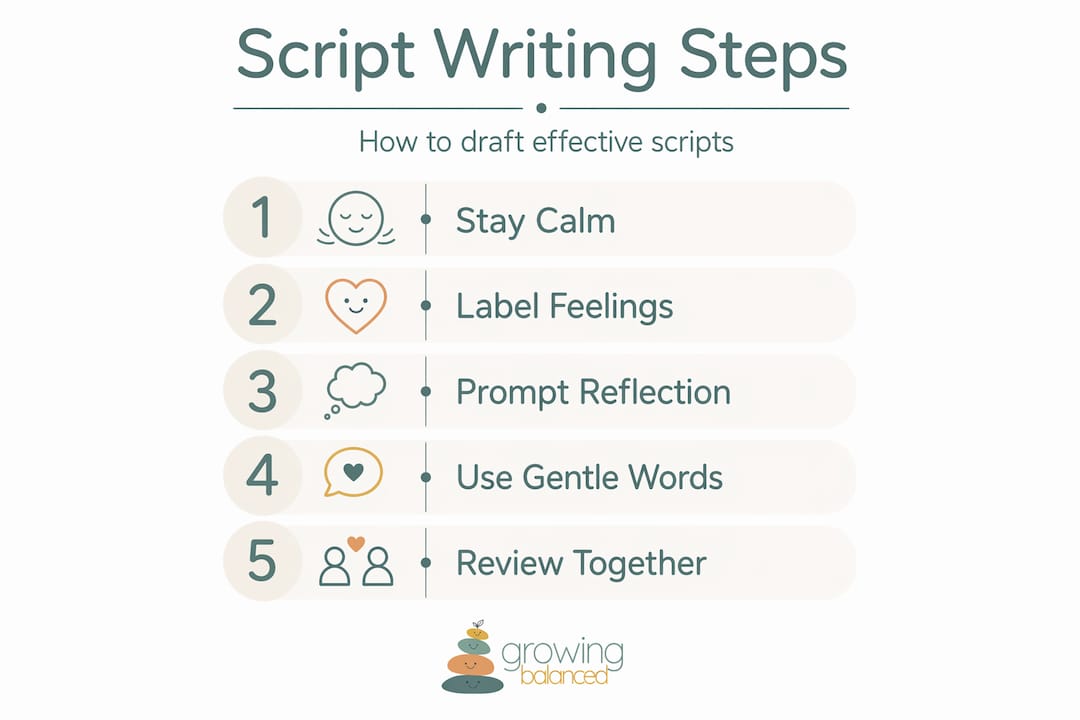
The most effective scripts follow a predictable arc: observe, validate, co-regulate, and offer a bridge forward. Here’s how to build that arc deliberately.
-
Start with observation and emotional labeling. Open your script by naming what you see without judgment. “I see your body is working really hard right now” is more effective than “Calm down.” Labeling emotions reduces amygdala activation and signals to the child that their inner state has been recognized.
-
Add validation that is neurobiological, not just verbal. The RAVE method (Reflect, Accept, Validate, Explore) can shift a nervous system from defensive to calm in roughly 90 seconds. Write a validation line that acknowledges the emotion without approving the behavior: “It makes sense you feel frustrated. That was really hard.”
-
Include co-breathing or physical presence. Instead of commands, script a shared action. “Let’s do one big breath together” places the caregiver alongside the child rather than above them. Co-breathing by the adult during stress is measurably more effective than verbal commands alone.
-
Offer a simple, limited choice. “Do you want to sit here or move to the corner beanbag?” gives the child micro-control at a moment when everything feels out of control. Keep the choice to two options maximum.
-
Build in a sensory component if needed. For children with sensory processing needs, weighted blankets, rhythmic movement, and low-pitched voices signal safety faster than words. Note this in your script as a parallel action: “Bring the heavy blanket over while speaking slowly.”
-
Plan your scaffolding exit. Scripts should include language that gradually fades support as the child stabilizes. “You’re doing it. I’m right here” becomes “You’re doing it on your own” over weeks of consistent use.
Pro Tip: The best scripts also prompt you to check your own body. Add a note at the top of any written script: “Slow your breath. Lower your voice. Soften your shoulders.” This prep step is not optional.
Here is a quick comparison to show the difference between escalating and calming script language:
| Escalating Language | Calming Script Language |
|---|---|
| “Stop crying right now.” | “I see big feelings. I’m right here.” |
| “You need to calm down.” | “Let’s take one breath together.” |
| “That’s not okay.” | “It makes sense you’re upset. That was a lot.” |
| “Look at me when I’m talking.” | “You don’t have to look at me. I’m staying close.” |
| “What is wrong with you?” | “Your body is telling us something. Let’s figure it out.” |
Common mistakes that undermine your scripts
Even the most carefully written scripts fail when delivered the wrong way or at the wrong moment. These are the patterns that trip caregivers up most often.
- Reasoning during dysregulation. No amount of logic reaches a child whose rational brain is offline. The prefrontal cortex goes quiet during threat states. Arguing, explaining, or problem-solving in the middle of a meltdown guarantees the script fails.
- Too many words. When caregivers are anxious, they talk more. This is the opposite of what works. A script overloaded with sentences floods the child’s already overwhelmed nervous system.
- Caregiver dysregulation on display. Mismatch between stressed body language and calm words increases child anxiety. If your jaw is clenched and your voice is tight, the script is irrelevant. The body communicates louder.
- Confusing validation with permission. Validation is not agreement. It is a neurobiological necessity for moving a child from survival mode into thinking mode. Saying “I get that you’re angry” does not mean the behavior was fine.
- Skipping sensory needs entirely. Verbal scripts alone miss the mark for many children. If a child is sensory-seeking or sensory-avoiding, words without physical support are incomplete.
“Teaching moments occur in calm states, not during crisis. The script’s job is de-escalation, not instruction.” — Flourishing Lives MI
After the storm passes, use a reflection conversation to rebuild connection and begin planting self-regulation language the child can eventually use independently.
Measuring whether your scripts are working

Writing a script is step one. Knowing whether it’s working requires deliberate observation over time. Use the table below to track your key indicators across a two-week period.
| What to observe | Signs it’s working | Signs to adjust |
|---|---|---|
| Child’s physical response | Slower breathing, relaxed posture | Escalating movement, turning away |
| Episode frequency | Fewer meltdowns per week | Same or increasing frequency |
| Recovery time | Shorter time to calm | Recovery takes longer than before |
| Child’s language | Uses script words independently | No spontaneous regulation language |
| Caregiver confidence | Delivering scripts without hesitation | Freezing or improvising during dysregulation |
Beyond the table, ask the child directly when they are calm: “What helps when things feel big?” Their answer will teach you more than any checklist. Scripts should be co-created with the child over time, with supports fading as self-regulation skills develop. Predictable routines and transitions also reinforce script effectiveness. When the structure around a child is consistent, their nervous system spends less energy anticipating the unknown.
My honest take on co-regulation scripts
I’ve seen caregivers arrive at workshops clutching printed scripts like life rafts. And I understand it. When you’re desperate for something to say, a script feels like solid ground. But here’s what I’ve learned after years of working with families and educators: the script is the least important part.
What actually shifts a child’s nervous system is your nervous system. The words are almost secondary. I’ve watched a caregiver say nothing at all and just sit beside a child, breathe slowly, and stay present, with better results than a perfectly worded validation script delivered with a tense jaw and rushed pace.
I’d also push back on the idea that longer, more detailed scripts are better. In my experience, the caregivers who do this well have internalized two or three short phrases and use them consistently. That consistency is what builds safety for the child.
Scripts evolve too. What works for a six-year-old will need to change by age nine. That’s not failure. That’s the whole point. The goal is always to need the script less, not more.
— Kelsey
Bring structure to your co-regulation practice
Scripts work best when they live inside a predictable routine. When children know what comes next, their nervous systems are calmer before a challenge even begins. Growingbalanced offers visual schedules and balanced routines built on occupational therapy principles, giving caregivers a practical structure that supports co-regulation every day, not just during meltdowns. Explore the tools at Growingbalanced to pair your scripts with the consistent daily structure that makes them work harder for your child.
FAQ
What makes a good co-regulation script for caregivers?
A good script is brief (one to two sentences), includes emotional labeling, and is delivered with a calm voice and relaxed body. The caregiver’s regulated nervous system matters more than the exact words used.
When should I use a co-regulation script?
Use scripts during or just before dysregulation, not during a full meltdown peak when reasoning is inaccessible. The best window is early in the escalation cycle, when the child’s nervous system is still reachable.
How is validation different from approving bad behavior?
Validation acknowledges a child’s emotional state as real and understandable without endorsing the behavior. Saying “I see you’re really frustrated” is a neurobiological signal of safety, not permission for the behavior that followed.
How do I know when to adjust a co-regulation script?
If recovery time stays long, meltdown frequency does not decrease, or the child shows no spontaneous use of regulation language after four to six weeks of consistent script use, it’s time to revise the script or add a sensory component.
Can children help write their own co-regulation scripts?
Yes, and they should, once they are calm. Co-creating scripts with children increases their buy-in and teaches self-regulation language they can eventually use without caregiver prompting.