
Home program components: OT recommendations for sensory kids
Unlock effective sensory support with the right home program components OT recommendations. Discover tailored strategies for your child today!

Home program components: OT recommendations for sensory kids
TL;DR:
- Effective home OT programs focus on daily, personalized sensory activities paired with visual routines and prompt fading to build independence. Heavy work, movement, oral, and tactile inputs regulate the nervous system, while structure reduces resistance and anxiety. Consistent adjustment and mindful caregiver presence are essential for sustainable progress.
Choosing the right home program components OT recommendations can feel like navigating a maze without a map. Your child’s occupational therapist hands you a list of activities, and suddenly you’re wondering which ones actually matter, how often to do them, and whether you’re doing it wrong when your child melts down mid-session. The good news: effective sensory regulation at home doesn’t require perfection. It requires the right structure, the right sensory inputs, and a plan built around your child’s specific nervous system. This article walks you through exactly that.
Table of Contents
- Key criteria for selecting effective OT home program components
- Essential sensory activity components in OT home programs
- Visual schedules and prompt fading techniques to build independence
- Comparison of core home OT program components for sensory regulation
- Practical recommendations for implementing a successful OT home program
- A fresh perspective on home sensory OT programs: beyond routines and checklists
- Support your child’s sensory needs with Growing Balanced
- Frequently asked questions
Key Takeaways
| Point | Details |
|---|---|
| Consistent sensory input | Daily sessions with targeted sensory activities help regulate your child’s nervous system and emotional state. |
| Visual schedules aid transitions | Using picture-based routines reduces anxiety and improves independence during daily tasks. |
| Prompt fading builds skills | Gradually reducing prompts helps your child perform tasks without support, fostering confidence. |
| Personalization is essential | An occupational therapist’s guidance ensures sensory activities match your child’s unique regulation needs. |
| Balanced sensory strategies | Combining alerting and calming inputs prevents overstimulation and maintains effective regulation. |
Key criteria for selecting effective OT home program components
Before you add a single activity to your child’s day, it helps to understand what separates a program that works from one that just adds stress. Not all occupational therapy home program designs are created equal, and the difference often comes down to a few foundational decisions.
Session length and frequency matter more than intensity. Home programs for sensory regulation typically include 15 to 30 minutes daily or 4 to 5 times per week, with 2 to 3 targeted sensory activities focused on emotional regulation. Short and consistent beats long and sporadic every time.
Personalization is non-negotiable. A child who is sensory seeking needs very different inputs than one who is sensory avoiding. Your OT should assess your child’s unique sensory profile before recommending any activities. Generic programs pulled from the internet are a starting point, not a plan.
Structure reduces resistance. Using visual schedules and routines gives your child a predictable framework that lowers anxiety before activities even begin. When kids know what’s coming, they spend less energy bracing for the unknown and more energy actually engaging.
Here are the core criteria to evaluate any home OT program suggestion:
- Frequency: Daily or near-daily sessions are most effective for nervous system regulation
- Duration: Keep individual sessions to 15 to 30 minutes to avoid fatigue and overwhelm
- Targeted activities: Limit to 2 to 3 sensory activities per session with a clear purpose
- Personalization: Activities should match your child’s sensory profile, not a generic checklist
- Visual support: Schedules and cues should be built into the routine from day one
- Progress tracking: A simple log or observation system helps you and your OT adjust the plan
Essential sensory activity components in OT home programs
The best OT program suggestions center on sensory activities that give the nervous system what it needs to reach a calm, organized state. Understanding why each activity works helps you use them more intentionally.
Heavy work is the cornerstone. Heavy work like pushing walls or carrying books provides regulating proprioceptive input that organizes the nervous system, calming children before challenging tasks. Proprioception is the body’s sense of where it is in space, and deep pressure to muscles and joints is one of the most reliable ways to bring a dysregulated child back to baseline.

Movement activities are alerting, not calming. This surprises many parents. Jumping on a trampoline or spinning can increase arousal rather than reduce it. That’s not bad, but it means movement should almost always be paired with a calming input afterward, like deep pressure or a weighted blanket, to avoid tipping your child into overdrive.
Oral and tactile inputs round out the toolkit. Chewing crunchy snacks, blowing through a straw, or playing with textured materials like kinetic sand or shaving cream can provide regulation throughout the day in small, natural doses. These are easy to weave into snack time or play without making it feel like therapy.
Here’s a practical sequence for integrating structured sensory routines into your day:
- Start with heavy work before a demanding task (homework, getting dressed, transitions)
- Follow alerting movement with calming deep pressure input
- Use oral or tactile activities during natural breaks or snack time
- End the day with proprioceptive input like a firm massage or weighted blanket to prepare for sleep
Common examples of each category:
- Heavy work: Carrying a backpack with light weights, pushing a laundry basket, wall push-ups
- Deep pressure: Weighted blankets, firm hugs, “sandwich” games with couch cushions
- Movement: Mini trampoline, animal walks, spinning on a swing
- Oral input: Crunchy vegetables, chewy snacks, drinking thick smoothies through a straw
- Tactile play: Playdough, water beads, sand trays, textured fabrics
Visual schedules and prompt fading techniques to build independence
Sensory activities alone won’t carry a home program. The structure around those activities is just as important. That’s where visual schedules and prompt fading come in.
Visual schedules work because they remove ambiguity. When a child with sensory challenges sees a picture-based sequence of their morning routine, they don’t have to rely on verbal reminders from a parent who may sound different every day. The schedule is consistent. It doesn’t have a tone of voice or a bad morning. That predictability alone reduces anxiety significantly.
Prompt fading is how independence actually gets built. Home OT programs use morning visual schedules with 3 to 4 activities, fading prompts over 3 to 5 seconds to build independence within 4 to 6 weeks. The sequence moves from physical assistance to gestural cues to verbal reminders and eventually to no prompt at all. Rushing this process is one of the most common mistakes parents make.
Key strategies for making visual schedules for independence work at home:
- Place the schedule in a high-traffic area your child passes naturally (kitchen, hallway, bathroom door)
- Use laminated cards with Velcro so your child can physically move completed tasks
- Model using the schedule yourself so it feels like a shared tool, not a rule
- Use a time delay of 3 to 5 seconds before prompting to give your child space to initiate
- Pair schedule completion with a specific reward your child values, like a Velcro star system or a preferred activity
Pro Tip: Don’t praise mid-routine. Wait until your child completes the full sequence before offering praise or a reward. Interrupting with “great job!” mid-task can actually disrupt the routine and make it harder to finish.
Comparison of core home OT program components for sensory regulation
Understanding each component individually is useful. Seeing them side by side helps you decide where to focus your energy first.
Visual schedules reduce transition resistance by up to 50% in routines using laminated picture cards and completion tracking. That’s a significant return for something you can set up in an afternoon.
| Component | Primary benefit | Best used for | Time investment | Independence goal |
|---|---|---|---|---|
| Sensory activities | Regulates nervous system directly | Calming before tasks, managing arousal | 15 to 30 min daily | Reduces dysregulation episodes |
| Visual schedules | Provides structure and predictability | Morning, bedtime, and transition routines | 1 to 2 hours to set up | Child follows routine without reminders |
| Prompt fading | Builds task independence | Any skill being learned or reinforced | 4 to 6 weeks per skill | Child initiates and completes tasks alone |
These three components work as a system. Sensory activities regulate the nervous system so the child can engage. Visual schedules show them what to do. Prompt fading teaches them to do it on their own. Remove any one piece and the others lose effectiveness. Explore how OT routine tools can support all three components in one place.
Practical recommendations for implementing a successful OT home program
Knowing the components is one thing. Keeping the program alive week after week is another. Here’s what actually works in real family life.
Build the sensory diet with your OT, not around them. Sensory diets must be personalized by an OT to match a child’s sensory profile to restructure the nervous system over consistent daily use. A sensory diet is a customized plan of sensory activities scheduled throughout the day. It is not a food diet. Your OT should be the architect; you are the builder.
Pair your inputs intentionally. If your child needs movement to get alert for school, follow it immediately with 5 minutes of heavy work or deep pressure. Skipping the calming step is like pressing the gas without knowing where the brake is.
“The goal of a sensory diet is not to eliminate all dysregulation. It’s to give the nervous system enough support that your child can recover faster and engage more fully.”
Practical tips for personalized OT home programs that last:
- Keep a simple daily log noting which activities you did and how your child responded
- Adjust the plan every 2 to 4 weeks based on what you observe, with your OT’s input
- Use mini-sessions (5 to 10 minutes) scattered through the day if a single session causes resistance
- Avoid introducing more than one new activity per week so you can isolate what’s working
- Celebrate consistency, not perfection. A week of 4 out of 7 days is a win worth noting
Pro Tip: Set a phone alarm for each sensory activity time slot. When life gets busy, the schedule disappears. Alarms make the invisible routine visible again without extra mental load on you.
A fresh perspective on home sensory OT programs: beyond routines and checklists
Here’s something most articles won’t tell you: the checklist is not the program. Parents who follow every step on paper but feel frantic while doing it often see less progress than parents who do fewer activities with genuine calm and presence. The nervous system your child is trying to regulate is deeply sensitive to the emotional environment around it.
Parents often overlook pairing alerting movement input with calming deep pressure afterward to maintain regulation throughout the day. But there’s a second thing they overlook: their own state. A dysregulated caregiver running through a sensory checklist at 7:45 a.m. while also packing lunches is not delivering a therapeutic experience. The activity might happen, but the co-regulation benefit is lost.
This doesn’t mean you need to be perfectly calm. It means the emotional quality of the interaction matters as much as the sensory input itself. Slowing down your voice, making eye contact, and staying present for even 5 minutes of heavy work does more than 20 minutes of rushed proprioceptive input.
Prompt fading also gets misunderstood. Many parents pull back prompts too fast because they’re excited about progress, then feel defeated when the skill regresses. Fading is not a straight line. It loops. A stressful week at school can temporarily require more prompting, and that’s expected, not failure.
The families who sustain effective home programs long-term share one thing: they treat the program as a living document, not a finished product. They use balanced sensory strategies that flex with their child’s changing needs rather than locking into a rigid plan that stops fitting by month two.
Support your child’s sensory needs with Growing Balanced
Putting all of this into practice is a lot to hold in your head, especially on a Tuesday morning before school.
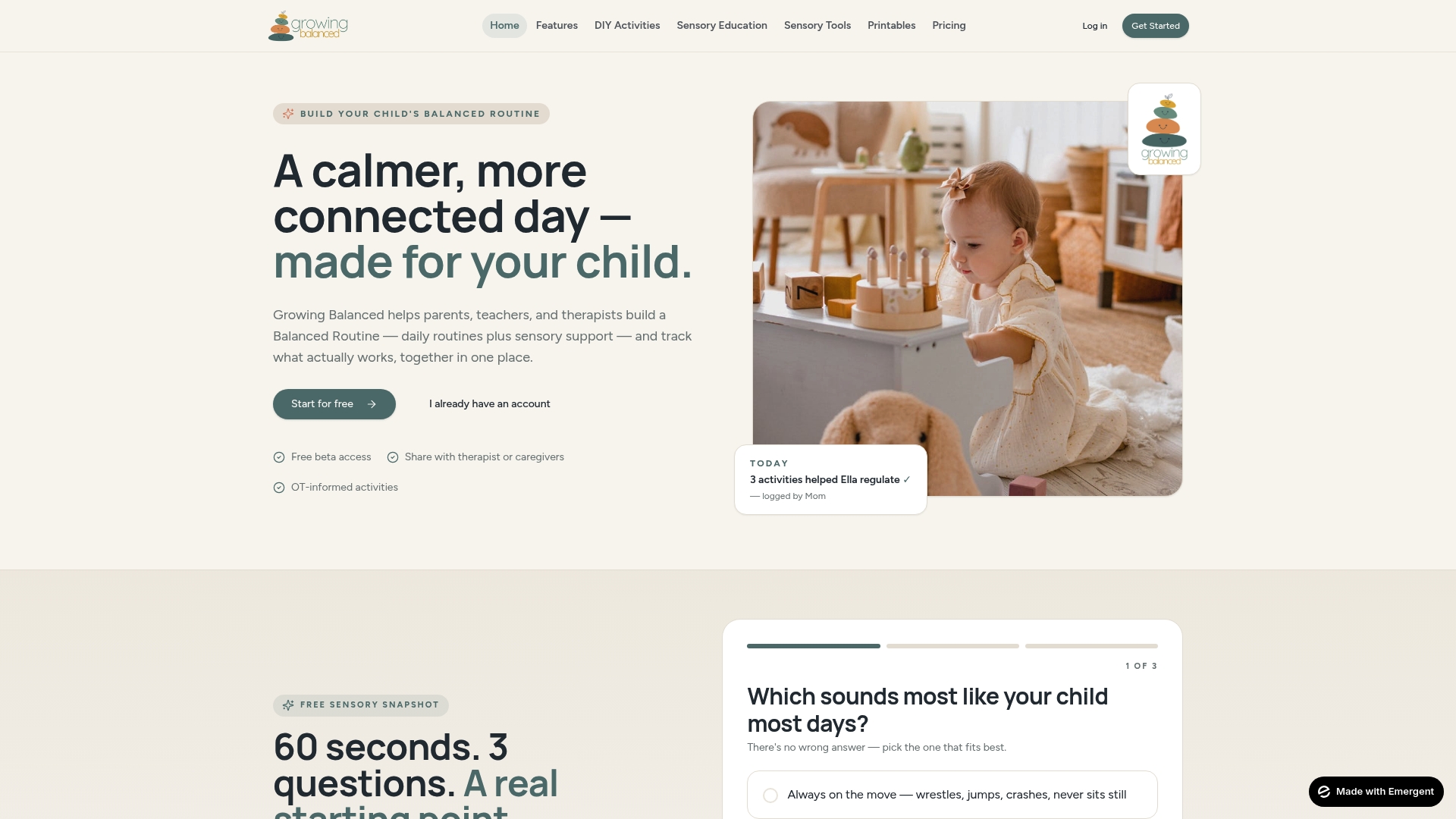
Growing Balanced was built for exactly this moment. The platform offers customizable visual schedules designed to reduce transition anxiety, with sensory activity suggestions grounded in OT best practices. You can personalize routines to match your child’s sensory profile, track daily progress, and share plans with your child’s therapist or teacher. Whether you’re just starting a home program or refining one that’s been running for months, Growing Balanced gives you the structure and the balanced routines solutions to make it sustainable. It’s the difference between knowing what to do and actually being able to do it, every day.
Frequently asked questions
How often should my child do sensory activities in a home OT program?
Most programs recommend daily sessions of 15 to 30 minutes or 4 to 5 times per week with 2 to 3 targeted sensory activities to support regulation. Mini-sessions spread through the day work just as well if a single block causes resistance.
What are prompt fading techniques and why are they important?
Prompt fading is the gradual removal of assistance to build independence and prevent your child from relying on a caregiver to initiate every task. It’s what turns a supported skill into an independent one.
Can visual schedules really help reduce anxiety and resistance during routines?
Yes. Visual schedules reduce transition resistance by up to 50% using laminated picture cards and completion tracking, making them one of the highest-return tools in any home OT program.
How can I personalize a sensory diet for my child?
Work with an occupational therapist who can assess your child’s specific sensory profile. Sensory diets must be personalized by an OT to match a child’s sensory profile and restructure the nervous system through consistent daily use.